Appendix G
The dependency map
Preface — Place and purpose of this appendix
An argument that claims much inevitably provokes one suspicious question: does it prove itself? A reader who wishes to be careful wants to know whether the conclusions flow from the premises, or whether the premises quietly assume in advance what the conclusions will later proclaim aloud. The first is an ordered structure; the second is a circular argument, however gracefully disguised.
This appendix answers that question directly, and it does so deliberately before the question is asked. It brings into view the dependency map of the corpus: which part rests on which foundation, where the weight lies, which anchors bear independently, and which links merely confirm without bearing anything. The principle is everywhere the same: dependency runs from foundation to what rests upon it; everything flows upward from Scripture; nothing flows back. Anyone who wishes to check whether the corpus proves itself (circular) or bears itself (ordered) can verify it here.
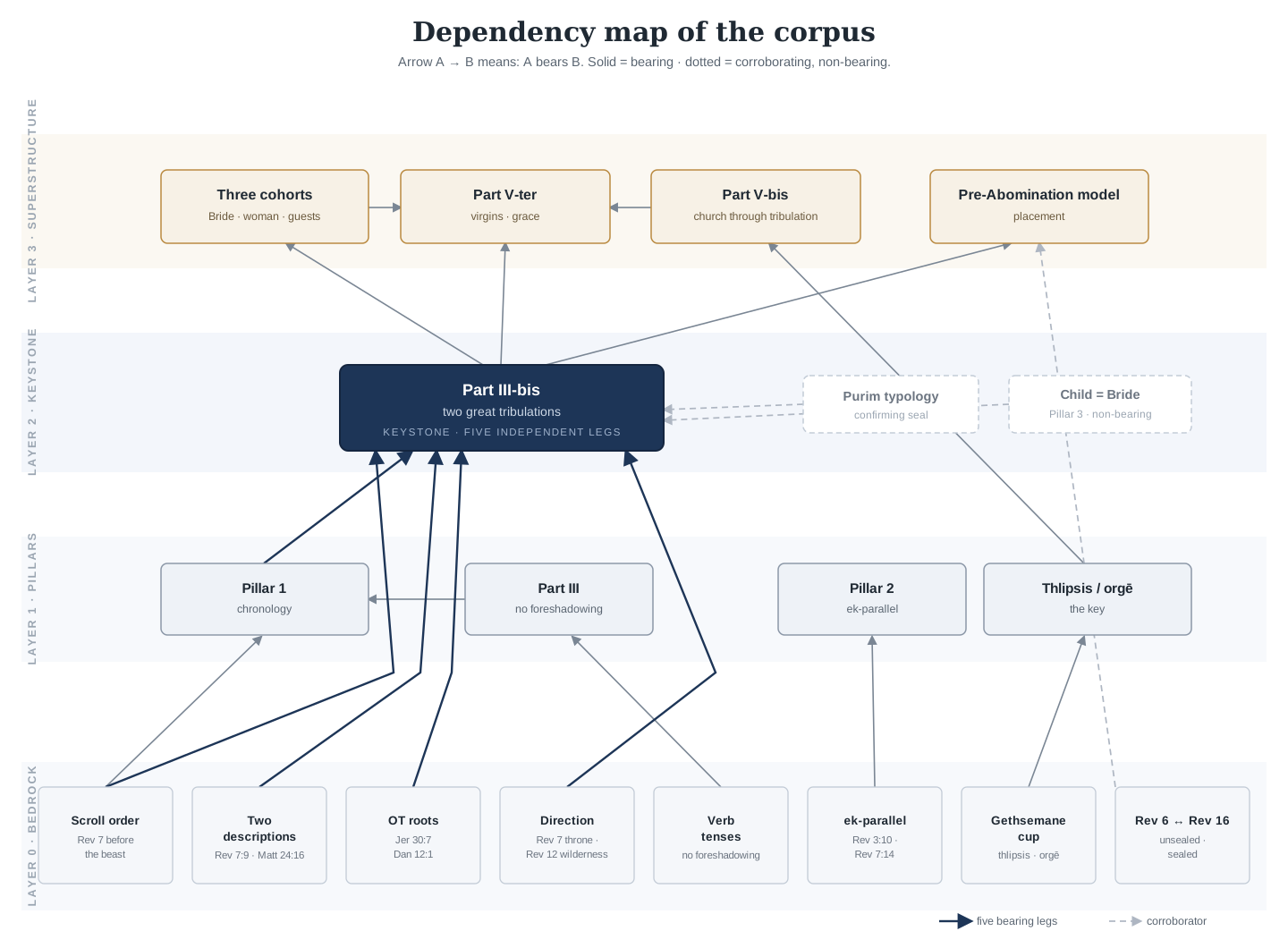
The structure here laid bare is that of a directed acyclic graph — in mathematics, a DAG: a network of nodes joined by arrows that all point in one direction and never form a loop. A corresponding diagram is inserted below in the web edition; the text that follows describes that same diagram in prose, so that it remains fully traceable even without the figure.
One delimitation belongs at the outset. This map brings into view the structural foundation — the eschatological architecture: the Pre-Abomination placement, the whole/peak distinction with its two cohorts, the three cohorts in the end-time. The dates (2027, 2028-2029, 2031, 2034) rest on a separate, parallel foundation: the chronology of God's Algorithm (the 457, the 31, the master clock). The bedrock of this map is therefore the structural bedrock, not the chronological. Both foundations, with their differing degrees of certainty, are treated in The Knowability of the Window. Let the reader hold fast to this distinction; it returns at the close.
I. The four layers of the corpus
The structure has four layers. At the bottom lies Scripture itself, read directly; upon it rest the pillars; upon them the keystone; and upon that the derived superstructure. Alongside these stand a few confirming witnesses that are attached but bear nothing. I describe the layers one by one.
I.1 Layer 0 — The bedrock
The lowest layer consists of data that are read directly from Scripture and depend on nothing within the corpus. They are the solid rock on which all else stands. Eight of these bedrock data bear the building:
the scroll-order of Revelation — Revelation 7 stands before the beast; the abomination-complex lies in Revelation 11-13; the two descriptions — the multitude from all nations, heavenly, before the throne (Rev 7:9) over against the fleeing Judean remnant (Matt 24:16); the Old Testament source-texts — Jacob's trouble (Jer 30:7) and Daniel 12:1; the directional imagery — Revelation 7 (upward, toward the throne) over against Revelation 12 (the woman, into the wilderness); the verb-tense pattern — present and future, hence no foreshadowing; the ek-parallel between Revelation 3:10 (tērēsō ek) and Revelation 7:14 (erchomenoi ek); the Gethsemane cup — the thlipsis/orgē data, the cup the Bridegroom has emptied; and the contrast Revelation 6 ↔ Revelation 16 — unsealed, self-hiding humanity over against sealed, blaspheming humanity.
None of these eight is a thesis; all eight are text. That is the first and most important property of the bedrock: it is not argued from the model, it is read before the model.
I.2 Layer 1 — The pillars
Upon the bedrock rest, directly, the pillars. They are the first derived nodes, but their dependency reaches no further than the text beneath them.
Pillar 1 — the chronological placement. Revelation 7 stands before the beast. This pillar reads the scroll-order, reinforced by Part III (see below).
Pillar 2 — the ek-parallel. The keeping out of the hour (Rev 3:10) and those who have come out of the tribulation (Rev 7:14) share the same preposition and the same scope. This pillar reads the Greek.
Part III — no foreshadowing. The verb-tense proof secures that the placement of Revelation 7 is a real arrival and not a foreshadowing. This part bears Pillar 1.
The thlipsis/orgē key. The core of the church-through-the-tribulation part: the separation between the tribulation — the Bride's portion with the Bridegroom — and the wrath, which the Bridegroom emptied in Gethsemane and which is never the Bride's portion. This key reads the Gethsemane cup together with the two text-series.
I.3 Layer 2 — The keystone
Above the pillars lies the keystone: the whole/peak distinction with its two cohorts. This is the part that distinguishes the one great tribulation in its whole — the week-wide thlipsis of Revelation 7:14 (the woe) out of which the Bride is taken away — and its peak — the post-abomination tribulation of Matthew 24:21, which is Jacob's trouble (Jer 30:7 / Dan 12:1; the Judean remnant, 1,260 days) through which the remnant is kept. Whole and peak rightly bear the same name — as a war and its hardest battle bear the same name — and over against that one tribulation stand two cohorts in opposed relation: the Bride out of it, the remnant through it.
The decisive feature of this keystone is that it stands not on one leg but on five independent legs at once, each read directly from the bedrock: (1) the chronology (Rev 7 before the beast — Pillar 1 plus Part III), (2) the abomination-trigger and the placement in Revelation (Rev 11-13 — the scroll-order), (3) the scope (all nations and heavenly over against Judean and fleeing — the two descriptions), (4) the Old Testament roots (Jeremiah and Daniel) and (5) the direction (the throne of Rev 7 over against the wilderness of Rev 12). The importance of this fivefoldness returns in part III: it is precisely what makes the keystone unshakable.
I.4 Layer 3 — The dependent superstructure
Above the keystone rises the superstructure — the parts that rest on the keystone plus the bedrock, and that themselves bear nothing further downward.
The Pre-Abomination placement rests on the keystone: the two cosmic sign-moments and the early placement of the rapture at the sixth seal (~2028-2029), before the abomination of Purim 2031. The Revelation 6/16 contrast corroborates this placement affirmatively.
The three-cohort structure — the Bride (taken up, the multitude before the throne, the male Child of Rev 12:5), the woman or remnant (fled, the wilderness, 1,260 days) and the wedding guests (gathered after the rapture) — rests on the Revelation 12 tableau within the keystone.
The church-through-the-tribulation part rests chiefly on the thlipsis/orgē key and on the chronology and the ek-parallel (Pillars 1 and 2, plus Part III). By this, this part is partly independent of the keystone — a property that proves significant in the fallback-table.
The virgins-and-grace part rests on the church-through-the-tribulation part and on the three-cohort structure; the guest-category it requires comes from the keystone.
I.5 The corroborators — attached, not bearing
Alongside the bearing structure stand a few witnesses that are fastened on but bear nothing. In the diagram they are marked with a dotted line.
The reading Child = Bride (the harpazō of Rev 12:5) — Pillar 3 in the older numbering — adds a second witness to the rapture, but is in the fallback-table (part IV) expressly shown to be non-bearing. The Purim typology seals the keystone confirmingly but does not bear it. And the Revelation 6/16 contrast moreover corroborates the chronology-pillar. These three enrich the testimony; none of the three holds any part upright.
II. The dependency edges, one by one
The diagram below shows each dependency as an arrow: read A → B as "A bears B" — B rests on A. Solid arrows bear; dotted arrows corroborate without bearing. The following edges deserve comment.
Part III bears Pillar 1. The verb-tense proof secures that the placement of Revelation 7 is a real arrival, not a foreshadowing. Without Part III an opponent could evade Pillar 1 along the foreshadowing escape-route; with Part III that route is closed.
The bedrock bears the pillars. Pillar 1 reads the scroll-order; Pillar 2 reads the Greek; the thlipsis/orgē key reads Gethsemane and the two text-series. None of these pillars hangs on a thesis; they all hang on text.
The five legs bear the keystone. The keystone rests on five bedrock legs at once — chronology, trigger and placement, scope, Old Testament roots, direction. None of them is derived from the keystone; all are read directly before it.
The keystone bears the Pre-Abomination placement. The whole/peak distinction with its two cohorts supplies the two cosmic sign-moments and the early sixth-seal placement on which the placement rests. The Revelation 6/16 proof corroborates this affirmatively.
The keystone bears the three cohorts, and these bear the virgins-and-grace part. The Revelation 12 tableau within the keystone supplies the three cohorts; the guest-category from it bears the virgin-grace of the virgins-and-grace part.
The thlipsis/orgē key, Pillars 1 and 2, and Part III bear the church-through-the-tribulation part. The church-through-the-tribulation rests chiefly on the key and on the chronology and the ek-parallel — and is thereby partly independent of the keystone.
The corroborators attach with a dotted line. Child = Bride adds a second witness to the rapture but bears nothing (part IV); the Purim typology seals the keystone but does not bear it; the Revelation 6/16 contrast moreover corroborates the chronology-pillar.
III. The non-circularity proof
Now the question of the preface can be answered. A circle would arise if something on which the keystone rests were in turn to depend on the keystone — if the keystone, in other words, were to prove its own foundation. That is not the case here, and for three reasons that are visible in the diagram.
First: the five legs of the keystone are all read directly from Scripture — the scroll-order, the words on the Mount of Olives, the two descriptions, the source-texts of Jeremiah and Daniel, the imagery of motion. None of them is derived from the whole/peak distinction. The keystone draws its bearing strength from the layer beneath it, not from itself.
Second: the parts that rest on the keystone — the Pre-Abomination placement, the three cohorts, the virgins-and-grace part — feed nothing back to the keystone. The flow goes upward and keeps going upward.
Third: every arrow in the diagram runs from a lower layer to a higher one. There is not a single arrow that runs back. That one check — is there a returning arrow? — is sufficient, and it comes out negative.
The flow is therefore strictly one-directional: text → pillars → keystone → superstructure. The corpus does not prove itself; it is established by independent textual data and then bears the derived parts. That is precisely the opposite of a circular argument.
IV. What falls if X falls? — the fallback-table
A second way to test the soundness of the structure is to remove a node in imagination and see what comes down with it and what stands. The following table does this, ordered from the lightest loss to the heaviest.
| If this falls | then this happens | and this stands |
|---|---|---|
| Child = Bride (Pillar 3) | one fewer witness to the rapture | the keystone, the Pre-Abomination placement, all parts — this table already shows it |
| The whole Rev 12 tableau | the three cohorts loses its tableau-ground | woman = remnant and Bride = the Rev 7 multitude from the remaining legs; the keystone on legs 1-4 |
| The keystone (the whole/peak distinction) | the Pre-Abomination placement falls back to pre-wrath; the cohorts simplify | "the Bride out before the wrath, at the sixth seal" on Pillars 1 and 2 plus the thlipsis/orgē key |
| The thlipsis/orgē key | the core of the church-through-the-tribulation part weakens | the chronology plus the ek-parallel still place the Bride before the wrath |
| Pillar 1 (chronology) | the deepest loss | Pillar 1 itself rests on the scroll-order plus Part III — the hardest datum of all to dislodge |
The table reads from light to heavy. The deeper one digs, the greater the loss becomes — but nowhere is there a collapse; everywhere there is an ordered fallback onto a lower, firmer foundation. There is not a single point whose fall takes the whole structure with it, except the bedrock-chronology itself, and that is precisely the most text-certain point of all.
V. What the map demonstrates
Three things, which a critic would wish to verify and which here stand in black and white.
Ordered, not circular. The corpus is a DAG: all dependency runs upward from Scripture to the derived parts, never back. The keystone does not prove itself.
No single weak point that bears the whole. The keystone rests on five independent legs; the softest link of the corpus — Child = Bride — does not reach the foundation; and even the fall of the keystone is a controlled fallback onto pre-wrath, not a collapse.
The line of attack is fixed. Anyone who would topple the whole structure must not find one ingenious objection, but dislodge the bedrock-chronology itself — the scroll-order of Revelation plus the verb-tense proof of Part III. That is the most text-certain point, not the weakest. An opponent who hoped to bring the whole down with the weakest link finds an ordered structure where he expected a house of cards.
With this the close returns to the distinction of the preface. This map has demonstrated the structural soundness — that the architecture bears itself and forms no loop. The question whether the dates bear is another question, which rests on another foundation, one honestly named as riskier; it is faced in the residual-points register and in The Knowability of the Window. The structure stands as an ordered building. What the structure lacks in certainty lies not in the structure but in the window — and there it ought honestly to lie.