Bijlage D
The Bride, the Wedding Guests, the 144,000, and the First Resurrection
Foreword — Place and Purpose of This Appendix
This appendix works out one coherent complex of questions that is touched upon in several places in the main text of The Master Clock of Revelation but is not treated exhaustively there: Who is the Bride? What is her relation to the wedding guests? Who are the 144,000? How do these groups relate to Israel-the-nation and the so-called sheep nations? And what is the structure of the first resurrection in which they are gathered?
It treats, in other words, the ecclesiology of the rapture — not the whole end-time chronology. The master clock itself, the seventieth week, the year-numbers, and the telescopic series from seal to trumpet to bowl are worked out in God's Algorithm and in the main text of The Master Clock; reference is made to these where the chronology touches the argument. This appendix stays focused on the Bride, the guests, the 144,000, and the resurrection.
The two hands. One key in advance, and it holds for the whole work: it reckons with a loose hand on the year-number and a firm hand on the structure. The architecture — the wrath which is not the night, the Bride who shares the night but escapes the wrath, the one olive tree, the wedding with its closed door — is defended as such, and it stands or falls upon its own grounds, whether the year-number is right or not. The numbers are application, not foundation. Let him who tests the year test it; but let him pass his judgment on the structure upon the structure. The structure is a fan (redundant, robust — strike one support away and it still stands); the chronology is a chain (as strong as its weakest link). This appendix defends the fan.
The textual basis is the Textus Receptus. Where significant variants exist between TR and the critical text, the TR reading is followed, and the variant difference is noted where it is structurally relevant to the argument.
This appendix follows the exegetical method of the main book: Scripture interprets Scripture, internal signal-words carry the heaviest weight, typological anchors are sought from the Old Testament, and theological traditions are not treated as arbiters but as witnesses consulted. Where Scripture does not speak decisively, the model remains open and its openness is honestly named (section XII).
One methodological note belongs at the outset. This appendix maps structure, sequence, and season — never the appointed day or hour. The Father has reserved the day and the hour to Himself (Matthew 24:36, Acts 1:7), and this appendix presumes nothing against that reservation. But the same Lord who withheld the day labored to make the season recognizable (Matthew 16:3, 24:33), and the sealed things were sealed to be opened toward the time of the end (Daniel 12:4, 9). The architecture set out here is therefore offered in the spirit of watchful discernment, not date-setting.
I. The Core Intuition: the Bride Shares the Night, Not the Wrath
Beneath all chronology lies one theological intuition, and it bears the whole model: the Bride shares the night of the Bridegroom, but never His cup of wrath, for that He drank to the dregs.
The New Testament knows two things that must be kept sharply apart. The first is tribulation — thlipsis —: pressure, persecution, the night, the cross-shaped life. This is the inheritance of the Bride: "in the world ye shall have tribulation" (John 16:33); "we must through much tribulation enter into the kingdom of God" (Acts 14:22); "the fellowship of his sufferings" (Phil 3:10). Whoever thinks the Bride is promised a smooth road without any trial reads neither the text nor the heart of the Gospel. The Bride follows the Bridegroom into His darkest night.
The second is wrath — orgē —: the judgment of God poured out upon the world. And this is not the inheritance of the Bride, for the most fundamental of all reasons: the wrath that was her due has already fallen — upon Him. The cup of wrath is a fixed scriptural image (Ps 75:8; Isa 51:17-22; Jer 25:15; Rev 14:10). In Gethsemane the Bridegroom prays: "let this cup pass from me" (Matt 26:39) — and He drinks it, to the last dregs. Therefore, and this is the deep and proper meaning of 1 Thessalonians 5:9, "God hath not appointed us to wrath." Not because the Bride knows no night, but because the wrath that was her due has already been drained. The Bride may share the suffering; the wrath never — for that would say that the cup of the Bridegroom was not enough.
A bolt upon 1 Thessalonians 5:9. Here a bolt belongs at once, for the purity of the argument stands or falls with it. That 1 Thessalonians 5:9 is given a place here is purely theological, not chronological. The verse teaches the Bride her relation to the wrath — she is not appointed to it, because Christ drank the cup — and thereby says that she is no vessel of wrath. It says nothing about when or how she escapes the hour of wrath. That when and that how rest entirely on other grounds: Revelation 3:10 (tērēsō ek), the place of Revelation 7, the ek (sections III and V). Whether one reads 5:9 as purely eternal or also eschatologically — the timing is untouched, for it never rested upon it. This verse is therefore not adduced here as a timing-proof; it returns only as bearer of the doctrine of the emptied cup, not of a date.
The post-trib re-reading of the chapter, frontally refuted. Against this reading the chapter itself is turned: "but ye, brethren, are not in darkness, that that day should overtake you as a thief" (1 Thess 5:4) would say only that the church is present but not surprised, because watching; and "God hath not appointed us to wrath" (5:9) would mean preservation-through, not removal. But the contrast-structure of the passage points the other way. Paul sets two groups over against each other: of them who say "peace and safety," it is said that destruction comes upon them "and they shall not escape" (ou mē ekphygōsin, 5:3); of the brethren, by contrast, "but ye" (5:4). The antithesis is thus escape over against non-escape — and what the ungodly do not escape, that the Bride does escape. That is not "present, but awake"; it is escape. And the Lord Jesus lays the same word beside it: "Watch ye therefore, and pray always, that ye may be accounted worthy to escape (ekphygein) all these things that shall come to pass, and to stand before the Son of man" (Luke 21:36) — to escape and to stand before Him, in one breath. It is moreover a contrast of sphere: the thief comes in the night (5:2) upon those who are of the night; the brethren are "children of the day" (5:5, 8), not in the night where the judgment breaks in.
And decisive is the connection with the preceding chapter. 1 Thessalonians 5 stands directly after the rapture-promise (4:13-18), and both close with the same comfort (4:18; 5:11). More than that: "that, whether we wake or sleep, we should live together with him" (5:10) repeats the living-and-the-departed of 4:15-17 — the rapture that unites both with the Lord. The salvation of 5:9 is therefore realized in the catching-up of 4:17; the mode that Paul himself sets beside "not appointed to wrath" is rapture, not shelter. Whoever makes of chapter 5 a preservation-through must dilute escape into not-surprised and sever chapter 5 from the mode of chapter 4.
It remains honest, wholly in accord with the bolt above: 5:4 by itself can also be read as "merely not surprised" (5:6, "therefore let us not sleep [...] but let us watch," feeds that theme), so that the chapter does not prove the rapture by itself. But the contrast-logic — escape over against non-escape, day over against night, and the connection with chapter 4 — leans toward escape, and strips the post-trib re-reading of its self-evidence. The verse bears no date; the chapter does bear a direction.
Here lies the heart of the model, and all that follows is its working-out. The Bride goes through the tribulation of the first part of the first half (seals 1-6, the night), and is taken away at the point where the birth-pangs turn to wrath, before she would have to taste the cup that for her is already drained. The chronology is the form; this is the soul.
II. One Great Tribulation with Its Peak, and the Two Cohorts
The most far-reaching objection comes with the text of the model in hand: "these are they which come out of great tribulation" (Rev 7:14, hoi erchomenoi ek tēs thlipseōs tēs megalēs) — with the article; whoever comes out of it must have been in it. And here the model must not — as an earlier formulation did — posit two unconnected great tribulations; that fights against the shared word and the double article tēs thlipseōs tēs megalēs. It says something simpler and stronger: there is one great tribulation, and it has a peak. The whole and the summit bear the same name, as a war and its fiercest battle bear the same name. And over against that one tribulation stand two cohorts in opposite relation: the Bride out of it, the remnant through it.
II.1 The Whole — the Seventieth Week
The great tribulation in the widest sense is the whole week: the cosmos and the earth and all that lives upon it brought into judgment, the seals and trumpets unfolded over the whole creation — disasters, plagues, birth-pangs. This is the tribulation out of which the innumerable multitude "of all nations, and kindreds, and people, and tongues" (Rev 7:9) comes; it stands already before the throne between the sixth and the seventh seal, before the trumpets, before the beast, before the abomination. The Bride shares the first part of the first half (seals 1-6) — the night — and comes out of it (ek) at the seam where the woe turns into wrath: at the sixth seal, before the abomination. Thus she truly comes out of the great tribulation — not through the whole week, but taken out of it before the peak.
II.2 The Peak — the Second Half, Satan's Hour
Within that whole lies the greatest tribulation — the forty-two months after the abomination: "for then shall be great tribulation, such as was not since the beginning of the world to this time, no, nor ever shall be. And except those days should be shortened, there should no flesh be saved" (Matt 24:21-22). This is "the hour of temptation, which shall come upon all the world" (Rev 3:10): Satan's hour, the short time in which the full power over the whole earth is given to him (Rev 13:7) — apart from the woman in the wilderness, who is kept — when even "the saints are given into his hand" (Dan 7:25). And it is precisely from this hour that the Bride is kept: tērēsō ek — the promise to Philadelphia (sections III and VI) — she is taken out of it before it dawns.
The focus of the peak is Judean: "let them which be in Judaea flee into the mountains" (Matt 24:16); "but pray ye that your flight be not in the winter, neither on the sabbath day" (24:20) — there the remnant is kept through the trial upon the earth, not, as the multitude of Revelation 7, glorified before the throne. It is the time of Jacob's trouble — "for that day is great, so that none is like it: it is even the time of Jacob's trouble; but he shall be saved out of it" (Jer 30:7) — the time of trouble for "thy people" (Dan 12:1), out of which the remnant is kept — not out of which it comes forth glorified.
II.3 The Shortening and the Bowls
After the forty-two months the transition dawns — the forty-five days between the 1,290 and the 1,335 (Dan 12:11-12) —: the dismantling of Satan's dominion, "and except those days should be shortened" (Matt 24:22), the deliverance at hand. And here lies an internal-chronology choice that the model makes explicitly: during the 1,260 days of the peak the heaven judges only through the two witnesses (Rev 11:3-6); no direct plagues of God fall. Only then, after the peak, in Elul-Tishri of the final year, do the bowls fall — "the seven last plagues, for in them is filled up the wrath of God" (Rev 15:1). "Last" presupposes a row before them; and that the wrath is filled up in these plagues places its climax after, not within, Satan's hour. Thus the peak is purely Satan's tribulation of the saints, and the bowl-wrath is God's reckoning with the beast-empire that follows upon it.
II.4 The Two Cohorts — a Fan, Not a Chain
From this it appears why the multitude of Revelation 7 and the remnant of Matthew 24 are not the same company, though they share the same tribulation. The multitude of Revelation 7 is up and out — before the throne, glorified; the remnant of Matthew 24 is down and in — into the mountains and the wilderness, fleeing across the earth. One people cannot at once flee to the mountains and stand glorified before the throne. They are two cohorts in two opposite relations to the one tribulation: the Bride taken out of the whole (before the peak), the remnant kept through the peak.
This answer rests not upon one link but upon several independent supports — the worldwide scope of Revelation 7 (ek pantos ethnous) over against the Judean boundary of Matthew 24; the throne-destination over against the wilderness-flight; the Old Testament root of Jacob's trouble; and the chronology that places the multitude already before the abomination before the throne. Strike one away, and the rest still bear the whole/peak distinction. It is a fan, not a chain. And however one counts: the Bride is already gone before the peak begins. She shares the night, not the peak, and not the wrath.
The honest test of this section. That whole and peak both rightly bear the name great tribulation is defensible — like the war and its fiercest battle — but it requires the reader to read that distinction along. That the bowls fall after the forty-two months, so that the peak is purely Satan's hour, is an internal-chronology choice, made explicit here and supported textually ("the last plagues," Rev 15:1). And the forty-five days as the "shortening" of Matthew 24:22 is a typological reading, not a compelling one. But the gain is essential: the keystone no longer fights against the article, for whole and peak rightly bear the same name — and the objection that bore the whole edifice is answered along the natural path of whole-and-peak.
III. "Coming Out": the Movement That Ek Describes
What follows describes the movement — going out from within, at a point — and no more than that. The preposition draws it; it does not bear it. What bears it stands elsewhere in this appendix: the address of Revelation 3:10 in VII.7, the place of Revelation 7 in the scroll in V.3-V.4, and the grounds of 12:5 in IV.7; the type-pair Lot/Noah stands below, as type and not as rule.
The objection "to come out of it, we must go through it" is half true and half false, and the distinction can be read off one word: ek.
Ek with the genitive means motion-out-of-the-interior, at a point of exit. It marks the going-out-from-within, not the full passage to the finish line. One comes "out of the water" by stepping out at a point, not by swimming to the far shore. The redemption-paradigms of Scripture all point in the same direction. Israel came out of Egypt (ek) at the exodus, in one night — not to Egypt's end, but out of it at a point, while Egypt continued thereafter and the judgment struck the pursuers, not them. Lot came out of Sodom before the fire fell — "haste thee, escape thither; for I cannot do any thing till thou be come thither" (Gen 19:22). Noah came into the ark before the flood; the door shut, then came the water.
In every case the movement is the same: out-at-a-point, before the judgment-end, not endured-to-the-end. Ek says: going-out from within, at a point. Which point, ek does not say — that the text decides in another way, by the narrative place of Revelation 7:9-17 between the sixth and the seventh seal. The multitude stands there already before the throne; its going-out is, at that point in the scroll, an accomplished fact (the aorist ēlthon, 7:13-14).
The ek binds two texts together. To Philadelphia it is promised: "I also will keep thee from (ek) the hour of temptation, which shall come upon all the world" (Rev 3:10 — tērēsō ek tēs hōras). Not dia (kept-through), not en (kept-in, while one remains within it), but ek — kept out of, away out of it. This is exactly the preposition of Revelation 7:14 (erchomenoi ek). The preposition draws the same movement in both texts; which keeping is promised, it does not decide. That is decided by the address of the hour: it comes "to try them that dwell upon the earth", and in this book that is the fixed name of a hostile class, to which Philadelphia does not belong. And three words date that hour: it is the hour (a bounded time, not temptation in general), which comes upon all the inhabited world (epi tēs oikoumenēs holēs) — while the seal-judgments still strike only a fourth part (Rev 6:8). The worldwide hour opens at the sixth-seal breach and reaches its worst in Satan's hour, the peak of the temptation (Matt 24:21; Rev 13:7); the Bride is taken out of it at its threshold, and is thus kept from the whole hour.
John 17:15, the strongest counter-example. Against this reading of tērēsō ek one text is brought, and it is the strongest: in John 17:15 the Lord Jesus prays "I pray not that thou shouldest take them out of the world, but that thou shouldest keep them from the evil" — tērēsēs ek tou ponērou —, and there it means preservation-while-one-remains-in-the-world, no removal. Does that not prove that ek need not here be an exit? The answer lies in the object. One can be kept out of a power while one remains within it: the believer remains in the world, but is held out of the grip of the evil one. But one cannot be in an hour and at the same time be kept out of that hour: a bounded time one escapes only by not being in it. The object in John 17 is a personal power (the evil one), from which one is protected within-the-world; the object in Revelation 3 is the hour — a span of time — from which one is kept only by absence. More than that: John 17:15 itself sets "take them out of the world" (arēs ek tou kosmou — which Jesus does not ask) over against "keep them from the evil" (which He does ask), and so shows that the same ek takes a different relation according to its object. The world is a place in which one remains; the hour is a time out of which one is held. The objection therefore confirms, on closer inspection, precisely the rule: one reads ek according to its object, and with a bounded hour that is: out of it, by absence. It does not compel — a dia-reader may persist — but it strips the sharpest objection of its edge.
And the counter-types — Passover, Noah — point to distinct companies. Against the ek of the Bride the same redemption-stories are turned the other way: Israel on the night of judgment did not go out of Egypt, but stayed in the houses, kept under the blood while the destroyer passed; and Noah rode through the flood, not out of it. Therefore, it is said, the church too is kept-through, not taken away. This is true, and the model does not deny it — there is a preservation-through-the-judgment, and it is genuinely scriptural. But two things turn the objection around. First, both types are bodily preservation: the firstborn did not die in the blood-marked house, Noah did not drown — one comes unharmed through the disaster. And that is precisely the mode of the woman in the wilderness, fed and kept the 1,260 days (Rev 12:6, 14): the remnant, bodily kept in place. Passover and Noah are thus types of the kept remnant, not of "the whole church safe through." Second, and decisively: precisely this bodily preservation is in the peak not promised to the saints in general — on the contrary. Against "the remnant of her seed" the dragon makes war (Rev 12:17); of the saints it is said that the beast "make war with them, and overcome them" (Rev 13:7), that they are "given into his hand" (Dan 7:25), slain (Rev 13:7; Rev 20:4). They are not spared as the firstborn; they are delivered up. The preservation that is invoked — the firstborn who does not die — is precisely what the tribulation-saints do not receive. (And whoever softens it into a spiritual preservation-in-martyrdom abandons the image itself: Passover is about the firstborn who is bodily spared, not about him who dies but is saved.)
Thus the counter-types confirm the distinction instead of breaking it. There are three relations to the judgment, not one: a bodily kept remnant (the woman — the Passover/Noah type), delivered-up saints (the remnant of her seed), and the raptured Bride who is taken up earlier (the Child, section IV). Without a raptured Bride there remains only the choice between bodily-spared (a part) and delivered-up (a part) — and neither is "the whole church safe through." The Exodus itself bears both modes: the blood that spares in place (Passover), and the going-out that leads forth (the exodus). The model assigns them to distinct companies; it does not flatten them into one.
IV. The Twofold Tableau of Revelation 12
What the previous sections derive from a comparison, John draws side by side with his own hand in one chapter. Revelation 12 gathers the whole argument into one, and confirms at once both the two cohorts and the whole/peak structure of the tribulation and the chronology. The chapter is, in this book's reading, the central panel of a cosmic-panel-section (Rev 12-14): no strictly chronological link between Rev 11 and Rev 15, but a vertical view from heaven upon the whole drama of the conflict, in which the time is gathered into one.
IV.1 The Woman in Travail, and the Two Answers
The chapter opens in the great tribulation: the woman "travailing in birth, and pained to be delivered" (Rev 12:2), and the birth-pangs (ōdines) are the image par excellence for the onset of the tribulation (Matt 24:8, archē ōdinōn). The dragon stands ready "for to devour her child as soon as it was born" (12:4). The scene is tribulation at its sharpest.
And over against that one tribulation John sets two distinct divine answers, side by side. The Child is caught up unto the throne: "And her child was caught up (hērpasthē) unto God, and to his throne" (12:5). The woman, by contrast, flees into the wilderness, where she is fed "a thousand two hundred and threescore days" (12:6, 14). The one vector is up and out (protection-by-removal); the other down and in (protection-by-preservation-in-place, kept through the wrath of the dragon). She is the fleeing remnant — exactly Matthew 24:16, exactly the 1,260 days of the great tribulation in the strict sense.
| The Child (12:5) | The Woman (12:6, 14) | |
|---|---|---|
| Act | hērpasthē — caught up | fled |
| Direction | upward, out | downward, in |
| Destination | the throne (heaven) | the wilderness (earth) |
| Mode | protection by removal | protection by preservation-through |
| Time | one moment (a point) | 1,260 days (a duration) |
| Cohort | the Bride (cf. Rev 7) | the remnant (cf. Matt 24) |
Who is the woman — and who shares her protection? This touches a disputed question, for both he who holds the whole church kept-through, and he who reckons himself — Torah-faithful believers, a "greater exodus" to a wilderness-refuge — among the woman, claims her protection. The text decides it more sharply than both. The woman is "clothed with the sun, and the moon under her feet, and upon her head a crown of twelve stars" (Rev 12:1) — unmistakably the image of Joseph's dream: the sun (Jacob), the moon (Rachel), the twelve stars (the twelve tribes, Gen 37:9-10). The woman is therefore Israel — the covenant people, the mother out of whom the Messiah came (Rev 12:5; Rom 9:5) —, not the church in general, and not a self-chosen Torah-keeping company of whatever descent; the sun-moon-twelve-stars iconography admits no other mother.
And within Revelation 12 itself stand two groups, not one, and precisely the protection separates them. The woman flees and is kept 1,260 days (12:6, 14), on eagles' wings — the Exodus-image (Ex 19:4). But of "the remnant of her seed, which keep the commandments of God, and have the testimony of Jesus Christ" (12:17) it is said that the dragon makes war against them. That decides both claims. Against the first: the kept one is Israel-the-mother, not the church; and the church — the Bride — is the Child, caught up. That is no lesser protection, but greater: not kept in the hour, but taken out before it dawns. And against the greater-exodus notion, sharper still: whoever appeals precisely to commandment-keeping and the testimony of Jesus to be the woman, describes himself in the very words of verse 17 — and that is the group against which the dragon makes war, not the group kept in the wilderness. The mark by which one claims the protection places the claimant precisely in the group fired upon. The protection-in-place belongs to the fleeing Israel-remnant (Judea, Matt 24:16); it is no open promise to everyone who reckons himself faithful.
Whoever would merge the two cohorts into one — the Bride goes through everything and comes out at the end — must explain why John, in one tableau, splits the answer in two. Were there one cohort with one tribulation-relation, then Revelation 12 would show one deliverance. It shows two. And the order confirms the chronology: the Child is caught up to the throne (12:5) before the woman flees (12:6) and before the dragon persecutes her (12:13) — first the removal, then the 1,260 days of wilderness-wrath.
Here lies at once the close of the objection that the Bride is "miraculously protected through it." Yes — there is a protection-through-it, and it is genuinely scriptural. But it is the mode of the woman, fed in the wilderness, not the mode of the Child, caught up to the throne. The protection of the Bride is removal. Both modes stand in one chapter, and the chapter assigns them to two different subjects.
IV.2 Hērpasthē — the Rapture-Word, Not the Ascension-Word
The verb of 12:5 is the root of harpazō. A systematic survey of the thirteen occurrences in the New Testament shows one and the same profile: harpazō is a sudden, forcible, exogenous action upon a passive object by an external agent (Matt 11:12; 12:29; 13:19; John 6:15; 10:12; 10:28-29; Acts 8:39; 23:10; 2 Cor 12:2; 12:4; 1 Thess 4:17; Jude 23; Rev 12:5). The object is snatched away; the act is unrelenting in its sudden character — and it is never voluntary self-action.
And precisely for that reason it does not fit Christ's own ascension. That is nowhere described with harpazō; the proper verbs are anelēphthē (He was taken up, received; Acts 1:2, 11, 22), anebēn (He went up; John 20:17), eporeuthē eis ouranon (Acts 1:11). Christ ascended by His own authority, with uplifted hands, blessing — calm, peaceful, announced, self-initiated; no snatching. But harpazō is the rapture-word: "we which are alive and remain shall be caught up together with them (harpagēsometha) in the clouds" (1 Thess 4:17). The verb therefore excludes the Christ-alone reading of the Child, and joins it seamlessly to the rapture of the Bride.
IV.3 The LXX-Echo of Isaiah 66:7
A second sign points the same way. The Greek of Rev 12:5 (eteken huion, arsen, ἔτεκεν υἱόν, ἄρσεν) echoes directly the Septuagint of Isaiah 66:7: "Before she travailed, she brought forth; before her pain came, she was delivered of a man child" — LXX prin tēn ōdinousan tekein [...] exefugen kai eteken arsen. The same verb (tiktō, aorist eteken) and the same gender-designation (arsen, verbatim the same form in both texts). This is no vague thematic echo: John uses Isaiah's exact words.
And the context of Isaiah is telling. Zion brings forth a man child before the real travail comes; thereafter Zion brings forth "in one day" a whole nation (Isa 66:8). Two levels of travail: the sanctified firstborn first, then the whole nation. Thus the huios arrēn of Rev 12:5 is born-and-caught-up at the first level, before the second dawns; and the "remnant of her seed" (12:17) — the broader harvest — is brought forth by the final travail. (The principle, not the letter: Rev 12:2 states that the woman is already in travail at the birth, so that the typology is fulfilled according to the principle, not one-to-one.)
IV.4 The Shift huios → teknon
A grammatical detail within Rev 12:5 confirms the corporate import. The verse begins with eteken huion, arsen (ἔτεκεν υἱόν, ἄρσεν, verbatim LXX Isaiah 66:7) — masculine huios — and ends with hērpasthē to teknon autēs — neuter teknon. A gender-shift within one verse. Huios in the Johannine Greek stresses individual identity and heir-position; teknon is more generic, often corporate, gender-neutral, and is used for groups. And John in particular uses tekna Theou systematically for the church as a collective (John 1:12; 11:52; 1 John 3:1-2, 10; 5:2). The shift from huion, arsen (the introduction of the prophetic identity, in Christ's firstborn-typology) to to teknon autēs (the catching-up act) fits a corporate entity with Old Testament typological identity. And 12:17 speaks explicitly of "the remnant of her seed" (tōn loipōn tou spermatos autēs): the Child is one seed-portion, the remnant another — both fruit out of the same mother.
IV.5 The Corporate Christ, via Ephesians 1:22-23
How the Child can be at once Christ and the Bride is unlocked by Ephesians 1:22-23: God has given Him "to be the head over all things to the church, which is his body, the fulness of him that filleth all in all" — to sōma autou, to plērōma. The church is identified with Christ Himself. Paul says it sharply in 1 Corinthians 12:12: "for as the body is one [...] so also is Christ" — not "so also is His body," but so also is Christ. And the Lord says to Saul not "why persecutest thou my body," but "why persecutest thou me?" (Acts 9:4). The identification is complete.
The Jewish wedding-structure clarifies how this already holds now. A first-century wedding knew erusin (betrothal) and nisuin (the consummation). From the erusin the bride was juridically already wife — she bore the name of the bridegroom, shared in his possessions, could be separated only by divorce. The nisuin did not make her wife; she was it already. For the church the baptism of the Spirit and the regeneration is the erusin-moment; the Spirit is the arrabōn (Eph 1:14, the earnest). From that moment the church is already juridically part of Christ — His body, His name (Rev 3:12), His inheritance, His position in the heavenly places (Eph 2:6) — and the marriage of the Lamb (Rev 19:7-9) is the public consummation. Therefore the Child can be called huios arrēn though the Bride is elsewhere feminine (Rev 19/21, nymphē, gynē): no typological stretch, but the direct reality of the erusin-position, in which the Bride can be addressed in the identity of the Bridegroom. The Child is therefore Christ-with-Bride as one corporate entity, with the Body caught up to where the Head has already established the position.
IV.6 The Destination and the Correspondence with Revelation 7
Whither is the Child caught up? "Unto God, and to his throne" (pros ton Theon, kai pros ton thronon autou). By itself that destination does not exclude the Christ-alone reading — Christ too goes to the throne. What tips the balance is the identity-correspondence with Revelation 7:9-17, the throne-scene par excellence, where the multitude stands "before the throne, and before the Lamb" (enōpion tou thronou kai enōpion tou Arniou). The place to which the Child is caught up is the place where the Bride is shown gathered; and the overcomer shares that place: "even as I also overcame, and am set down with my Father in his throne" (Rev 3:21). Thus Rev 12:5 shows the act by which she arrives, and Rev 7:9-17 the state in which she has arrived — two perspectives, one event. The verbs are complementary, not contradictory: hērpasthē is the catching-up seen from below (vertical, from the earth to the throne); erchomenoi (Rev 7:14) the arrival seen from heaven. And the parallel reaches further: the Child ≅ the great multitude (both the Bride in her full realization); the woman ⊇ the 144,000 (Israel as a whole, with the 144,000 as a special part within the mother).
IV.7 What the Child Bears, and What It Costs
Earlier editions called this identification the weakest link of the whole and booked it as "second witness, not a pillar". That judgment is withdrawn here, and it is withdrawn on the ground of the texts and not out of a need for firmness.
What it bears is threefold: the birth (Revelation 12 touches the end-time birth of the prophets verbally and Bethlehem not once — IV.3), the name (in Paul the body bears the name of the Head, 1 Corinthians 12:12) and the narration. That third ground is a rule of the book itself: all retrospect in Revelation is qualification — "as it had been slain" (5:6) is the type — and nowhere narration, while 12:5 narrates. The consequence for 12:5 is compelling: whoever places the verse in the year 30 makes of it the only narrated past in Revelation. The five retrospect-passages on which that rule rests stand in Revelation Unsealed, in the commentary on 1:19 and 4:1; the first two grounds are fully worked out in The Woman in the Wilderness, in the chapter on the birth-pangs of the prophets.
What it costs stands here unvarnished. This is not the reading of the history of interpretation, and the burden of proof lies with whoever departs from it. Two data do not choose: the devouring dragon, and 12:10, which names "his Christ" beside "our brethren". The corporate prōtotokos is absent here, and the two orders of 1 Corinthians 15:23 forbid drawing Head and members in one catching-up — hence the formulation: the Head is presupposed, not caught up. That price is tested, with the counter-reading alongside, in The Pre-Abomination Model. The proper weighing is therefore not "weakest link" but "bearer with booked price". Revelation 12:5-12 bears the rapture together with 2:26-28 and 3:21 (the shared predicates), with 12:11-12 (the arrival-report), with Isaiah 66:7 (before the pain) and with Daniel 12:1 (the date of 12:7). Whoever takes away one of those supports keeps 12:5 as a possibility. Whoever reads them together has, beside Revelation 3:10 and Revelation 7:9-17, a third place where the rapture stands.
V. The Sixth-Seal Position and the Innumerable Multitude
That the rapture falls at the sixth seal — before the abomination, before even the trumpets — is confirmed in several ways: by the question whether the seals are future at all, by the structure of Revelation, by the state of mankind at the sixth seal, by the nature of the innumerable multitude that appears there, and by the nature of the cosmic signs.
V.1 Are the Seals Future at All?
First a prior question, for without it the whole position hangs in the air. Preterism reads the seals as already fulfilled (the year 70); idealism as timeless symbolism. The model reads them futuristically — as the unfolding of the seventieth week —, and that on the ground of the text itself. The seals open a scroll that none could open but the Lamb (Rev 5); they lead to the trumpets and the bowls, and these culminate in the visible return and the resurrection (Rev 19-20) — events that have been absorbed by no first-century fulfillment. The cosmic consummation of Rev 19-22, the bodily resurrection-order, and the millennium are unfulfilled; a reading that lets the seals be absorbed in the year 70 must explain all that away. The seals therefore stand at the beginning of the end-time series, not behind it.
V.2 Revelation Predominantly Chronological, with One Cosmic Panel
The structure of Revelation is telescopic and predominantly sequential, with one clearly demarcated cosmic-panel-section (Rev 12-14) that reaches back and forward. Against the sequential reading stands the weightiest structural objection: the recapitulation-thesis (Hendriksen, Beale), which reads seals, trumpets, and bowls as three parallel series that each retell the same period and all end at the return. Were it right, then the sixth seal could just as well fall at the end, parallel to the bowls, and the sixth-seal-before-the-abomination position would lapse.
Three things plead for the nested, sequential reading of the judgment-backbone. First the nesting itself: the trumpets lie within the seventh seal (Rev 8:1-2) and the bowls within the seventh trumpet (Rev 11:15; 15-16) — the seventh of each series unfolds the next. That is no parallelism but inclusion, and inclusion is by definition sequential. Second the word last: the bowls are "the seven last plagues" (Rev 15:1) — "last" presupposes a row before them. Third the crescendo: the seals strike a fourth part (Rev 6:8), the trumpets a third (Rev 8:7ff), the bowls the whole — a rising series, not a threefold retelling. The model frankly acknowledges that Revelation locally recapitulates — the interludes, the cosmic panel of Rev 12-14 reach back and forward —; but it needs only that the seal-trumpet-bowl backbone be nested-sequential, and that it is.
V.3 The Sixth Seal as Pivot; Revelation 6 over against Revelation 16
At the sixth seal all mankind hides itself — "the kings of the earth, and the great men, and the rich men, and the chief captains, and the mighty men, and every bondman, and every free man" (Rev 6:15) — but no one bears the mark of the beast, no one is even aware of it. At the bowls, by contrast, men bear the mark, blaspheme God, and do not repent (Rev 16:2, 9, 11). The state is wholly other. The deliberate echo between the list of ranks that hides itself (Rev 6:15) and the same ranks that are marked (Rev 13:16) dates the sixth seal before the beast: at the sixth seal there is as yet no mark, so the beast is not yet in power, so the sixth seal falls before the middle of the week. The rapture that is bound to that seal therefore falls before the abomination — precisely what the name Pre-Abomination says.
And the scope confirms it. The hōra tou peirasmou of Revelation 3:10 comes "upon all the world" (epi tēs oikoumenēs holēs) — worldwide —, while the seal-judgment of Revelation 6:8 still strikes only "the fourth part of the earth." The worldwide hour is therefore not the seal-phase itself but the wrath-hour that follows upon it and reaches its worst in Satan's hour; and it is precisely from that that the Bride is kept ek.
V.4 The Innumerable Multitude — the Raptured Bride, Not Martyrs
Against the rapture-reading it is objected that the multitude which comes "out of great tribulation" (Rev 7:14) may just as well be martyrs — those who have died, not those raptured. But the text gives no ground for it. In the whole seal-series and the first trumpets nowhere is a mass martyrdom described; the only martyrs named are "the souls of them that were slain for the word of God" — and these stand under the altar (Rev 6:9), a bounded group who are given to wait "yet for a little season" (6:11), not an innumerable multitude before the throne. An innumerable host of martyrs simply has no textual ground at this point. What the text does show is a multitude that suddenly, between the sixth and the seventh seal, stands glorified before the throne — precisely where a rapture would place it.
Who is that multitude? Not merely the NT-believers who have lived since Pentecost, but the complete company of the already-glorified at the rapture-moment: the firstfruits of the Old Testament saints who already arose ("many bodies of the saints which slept arose," Matt 27:52-53 — polla, many, not all: a firstfruits-pledge); the remaining departed of old and new covenant, bodily raised at the rapture; and the living, in an indivisible moment changed. Together they form the one Bride in her full realization — the fulfillment of "that they without us should not be made perfect" (Heb 11:40; see sections VI and VIII).
Their garments confirm it. The "white robe" (stolē leukē, Rev 7:9) is no specific martyr-mark but the glorification-garment, given also to the four and twenty elders (Rev 4:4), to the overcomer of Sardis (Rev 3:5), counseled to Laodicea (Rev 3:18); the proper bridal garment is the byssinos of Rev 19:8. The "palms in their hands" and the salvation-cry "Salvation to our God which sitteth upon the throne, and unto the Lamb" (Rev 7:9-10) carry the triumph-character of the complete glorified company, not of a martyr-portion within it.
And the placement of Revelation 7 at that point is no accident but functionally fixed. The sealing of the 144,000 (7:1-8) must take place before the trumpets, that the trumpet-judgments not strike them — "that they should not hurt the earth [...] but only those men which have not the seal of God in their foreheads" (Rev 9:4). That sealing is therefore chronologically anchored at the seam between the sixth and the seventh seal — and the innumerable multitude that immediately follows it (7:9) stands at that same seam: it is there, before the throne, before the trumpets. Thus the structure of Revelation 7 itself confirms the rapture at the sixth seal: the earthly sealed below, the heavenly multitude above, upon one and the same hinge.
A marker that announces the new category. Whoever places the multitude of Rev 7 before the throne already before the beast expects the text to mark the after-the-rapture martyrs separately — and it does. "Blessed are the dead which die in the Lord from henceforth (ap' arti)" (Rev 14:13), spoken just after the mark-persecution of 14:9-12, presupposes a change at that point: from henceforth those who die in the Lord are blessed in a new way. The blessing would be superfluous if it always held; it marks a new category — the mark-martyrs — that arises after the rapture and rises in the second phase (sections VI and VII). This supports the reading of Rev 7 as the pre-beast heavenly multitude all the more forcibly.
V.5 The Cosmic Signs and Matthew 24:29
The sharpest objection against an early rapture is that Jesus places the cosmic signs "immediately after the tribulation of those days" (Matt 24:29) — sun darkened, moon without light, stars falling — and thereafter lets the Son of man appear. If those signs come after the tribulation, how then can the rapture be early? The answer has four layers. First: the cosmic-sign language is a repeatable prophetic idiom (Joel 2; Isa 13; Isa 34) that can fall more than once, no unique moment. Second: "after the tribulation of those days" is after the tribulation of Matthew 24:21 — the Judean, second-half tribulation — not after a seven-year totality; and that is wholly consistent with a second-half return. Third: the gathering of Matthew 24:31 ("and they shall gather together his elect") is the Old Testament regathering of Israel, not the rapture of the Bride. Fourth: the sixth-seal-signs (Rev 6:12-14) mark the onset of the wrath, not the end — they open the Day of the LORD, and they fall before the trumpets. The cosmic signs therefore appear twice: at the sixth seal (the wrath-onset, with the rapture) and at the return (after the Judean tribulation). Matthew 24:29 speaks of the second; it does not undermine the first.
The gathering of Matthew 24:31: not necessarily the rapture. That the third layer stands honestly requires a further word, for the sharpest objection against an early rapture is that Jesus places the appearing and the "gathering" "immediately after the tribulation of those days" (Matt 24:29-31), with a trumpet-sound — and that sounds like the rapture of 1 Thessalonians 4 and 1 Corinthians 15. But read carefully what the text says, and what it does not. Matthew 24:31 reads: "And he shall send his angels with a great sound of a trumpet, and they shall gather together his elect from the four winds, from one end of heaven to the other." Not a word about the resurrection of the dead; not a word about being changed or incorruption (1 Cor 15:52-53); no caught up (harpazō, 1 Thess 4:17); no to meet the Lord in the air (1 Thess 4:17). Yet 24:31 shares with Paul the coming on the clouds, the trumpet, the angels and the gathering, and gather together (episynagō) is Paul's own word for "our gathering together unto him" (2 Thessalonians 2:1). The identification with the rapture is possible, not compelling. The timing is decided by Revelation: the multitude at the seam (Rev 7:9-17), the Bride in heaven before the Rider rides out (Rev 19:7-14).
What the text does give can be weighed on three counts. First the acting person: in both texts the Lord comes Himself (Matthew 24:30; 1 Thess 4:16). Matthew names the angels as those who gather; Paul names the voice of an archangel and leaves unsaid who catches the believers up. Angels do the harvest-work of the regathering. And precisely that angel-harvest-work is Jesus' own image for the end of the age: at the harvest the angels go out, gather and separate the tares from the wheat (Matt 13:39-43, 49) — a judgment-ingathering, not the personal catching-up of the Bride. Second the movement and the idiom: not upward-to-meet-Him, but "from the four winds, from one end to the other" — and "from the four winds" is throughout Scripture the regathering of scattered Israel (Deuteronomy 30:4 LXX, "from the end of heaven to the end of heaven"; Zechariah 2:10 LXX (Eng. 2:6), "from the four winds of heaven"; Isaiah 11:12; cf. Matthew 23:37 and the mourning of the tribes, Zechariah 12:10-12), not the rapture of the church. The trumpet is the great trumpet of Isaiah 27:13, with the same words in the LXX, from the Isaiah block that also gives the resurrection (26:19) and "death is swallowed up" (25:8; 1 Corinthians 15:54); in the prophets ingathering and resurrection belong together (Ezekiel 37:9-12; Daniel 12:1-2). It is a shared feature. Third the elect: in Matthew 24 itself "his elect" are those who are in the tribulation — for their sakes the days are shortened (24:22), and them the deceivers seek to mislead (24:24). That the Bride is no longer among them then does not follow from Matthew 24 but from Revelation 6-7 and 19:7-14.
There are therefore two gatherings, not one: the Bride, caught up to meet the Lord (1 Thess 4, earlier); and the elect remnant, regathered by angels from the four winds at the appearing (Matt 24:31). The same word-field (episynagō; cf. episynagōgē, 2 Thess 2:1), two events — as "the great tribulation" names the whole and the peak. The identification of 24:31 with the rapture is possible, but not compelling; a pass-through reader can maintain it (cf. Revelation Unsealed, E·6).
And "the one taken, the other left"? A related move leans on the sequel (Matt 24:37-41): as the flood in Noah's days "took them all away" while Noah was left, so at the coming "the one shall be taken, and the other left" — and, it is said in Noah-fashion, the one taken is swept away in the judgment, the one left is kept on earth. But the verb contradicts that. The flood took away — airō (24:39) —, while "the one is taken" is paralambanō (24:40): precisely the word of John 14:3, "I will [...] receive you unto myself." The one taken is therefore taken to the Lord, not swept away; the one left remains for the judgment. This scene stands within the parousia-passage, but its parallel, Luke 17:26-35, is placed by the model at the seam: "the day that Lot went out of Sodom" (Luke 17:29). Ordinary life suddenly broken off, the one taken to the Lord, the other left for the judgment that then begins: read so, it belongs to the beginning of the coming, not to the judgment-separation of the appearing; that placement is a choice of the model. It therefore does not prove the preservation-on-earth that one would read out of it, and it does not shift the rapture of the Bride to the climax either.
And the cosmic signs: not one darkening, but a series. There remains the objection that Matthew 24:29 (sun darkened, moon without light, stars falling) seems word-for-word like the sixth seal (Rev 6:12-14), so that one equates the two and lets the rapture fall there. The decisive answer is chronological, and it rests on the nested series (section V.2). Suppose the sixth seal were the end, equated with Matthew 24:29 — then the order does not fit: after the sixth seal there come, after all, the seventh seal, the seven trumpets (with Abaddon-Apollyon, Rev 9:11), and after that the seven bowls. The sixth seal stands therefore far before the end of the judgment-series; Matthew 24:29 stands after everything, just before the appearing (24:30). They cannot be the same darkening: in Matthew 24 it falls after the great tribulation, at the sixth seal it falls before it. Whoever would yet make them coincide must place the trumpets and bowls after the return — absurd — or take refuge in the recapitulation-thesis, which section V.2 refutes. The nested series therefore directly disarms the equation of the sixth seal with Matthew 24:29.
And Scripture does indeed know more than one darkening: not only at the sixth seal, but also later in the week — the fourth trumpet darkens a third of sun, moon, and stars (Rev 8:12), the bowls shroud the beast-empire in darkness (Rev 16:10) —, and finally at the appearing (Matt 24:29). It is a repeatable, rising idiom (Isa 13:10; 34:4; Joel 2), no single date. Joel proves that himself: his prophecy is no single day — Peter applies it already partly to the outpouring of the Spirit (Acts 2:16-21), while the cosmic part still waits. Precisely therefore Joel's "before the great and the terrible day of the LORD come" (Joel 2:31) fits well upon the sixth seal: a darkening that opens the Day, long before the darkening that closes it. Joel is here therefore illustration of the pattern, no conclusive proof — the conclusive proof is the order itself.
2 Thessalonians 2: the revelation is the covenant, not the abomination. Here lies the heaviest rapture-objection, and it deserves — though the fullest treatment comes in the main text — also here a brief-but-complete answer. Paul couples "the coming of our Lord Jesus Christ, and our gathering together unto him" (2:1) and says that that day does not come "except there come a falling away first, and that man of sin be revealed" (2:3). The post-trib reading equates that revelation with his sitting in the temple (2:4) — the abomination — and concludes: the gathering follows after the abomination. But that equation is not given; it is assumed. Read 2:3-4 with Daniel 9 beside it, and the man of sin proves to have a career in two times: he makes the covenant strong for the many with overwhelming power at the onset of the week (Dan 9:27a), and in the midst he causes the sacrifice to cease and sets up the abomination (Dan 9:27b). Precisely those two phases Paul names: revealed (2:3 — the onset, the covenant) and "so that he as God sitteth in the temple of God, shewing himself that he is God" (2:4 — the midst, the abomination). Verse 4 therefore does not stamp the moment of the revelation; it is an identifying clause that points to the man of sin at his summit, not at his appearing.
Two lines confirm that the revelation is the onset and not the midst. First the name: the son of perdition is called in all Scripture only two men — Judas (John 17:12) and the man of sin (2 Thess 2:3). And Judas was the son of perdition already before Satan entered into him (John 13:27): marked at the beginning, fully possessed at the end. So also the man of sin — manifest as covenant-prince at the onset, fully satanic in the abomination; the revelation precedes the full possession. Second the restrainer (ho katechōn, 2:6-7), who holds back the full manifestation "until he be taken out of the way," whereupon — says 2:8 — the wicked one is fully revealed, to be destroyed at the appearing. There are therefore two unveilings of one progressing revelation: the appearing (the covenant, 2:3, before the Day) and the full self-deification (the abomination, 2:8, after the removal of the restrainer). The rapture of the Bride at the sixth seal falls between the two. Paul uses the same verb three times here (2:3, 6, 8); that the first revealing is the covenant, the model reads from Daniel 9:27, not from 2 Thessalonians.
Thus 2 Thessalonians 2 confirms the order of the model — and without wrenching loose the gathering of the Day. The falling away and the revelation-as-covenant precede (the onset); then the Day opens with the sixth seal, and the gathering falls (2:1); then, in the midst, the abomination (2:4); then, at the return, the climax that destroys the wicked one (2:8). 2:1 and 2:8 name one coming. The model reads it as a time with a beginning (the gathering together) and a climax (the appearing); that is a choice of the model, not a datum of 2 Thessalonians 2. And the falling away? The model confesses a real apostasy of professors in the last days, which swells toward the end and finds its focus in that covenant itself: the many who range themselves under the false prince thereby make their apostasy from the true Messiah manifest. Apostasy and revelation are thus two sides of one event at the onset, both before the sixth seal.
(Honestly: this reads the revelation of 2:3 as the covenant, not as the temple-seat — a minority reading over against him who lets it coincide with the self-deification. Its strength is that it fits seamlessly upon Daniel's two-phase career, and that it lets the gathering stand at the Day instead of wrenching it out. The full working-out of the Day-as-period-with-two-faces stands in the main text.)The sanctuary-question — open space. Does this model presuppose a rebuilt temple? Strictly it requires only a holy place on the temple mount and a functioning tamid — the continual sacrifice — that the coming prince causes to cease (Dan 9:27; 11:31). The architectural form that satisfies that requirement — a fully rebuilt temple after the Mosaic-Solomonic pattern, or merely a restored altar with continual service on a sanctified place, as at the return from Babylon altar and tamid were restored before the temple-building stood (Ezra 3:2-6) — the text leaves undecided. This point returns in section XII. (The millennium-temple of Ezekiel is distinct from this: the defiled sanctuary that the man of sin occupies is not the pure temple of the age to come.)
VI. The Demarcation of the Church: Who Is the Bride, Who Are the Guests
Here lies the heart of the appendix, for the whole rapture-doctrine hangs upon one question: who precisely is the Bride, and who are the wedding guests? The model answers that question not temporally — "whoever happened to believe before the rapture" — but along two boundaries that Scripture itself draws. The first boundary runs between him who is ready and him who is not ready: between a living, fruit-bearing, persevering faith and a lamp without oil. The second runs between the Bride — the whole church of all ages — and the wedding guests who come to faith after the rapture. The first boundary is drawn by the parable of the ten virgins, the parable of the sower, and the warnings of Hebrews; the second by Romans 11 (the one olive tree) and Hebrews 11-12. Both are set down here — and, deliberately, so formulated that no school of doctrine need reject the rapture-structure on its particular grounds.
VI.1 The First Boundary — Readiness: the Ten Virgins in the Danger-Zone
The image that draws the first boundary most sharply is the parable of the ten virgins (Matt 25:1-13), which the Lord Himself sets in the rapture-key: "Watch therefore, for ye know neither the day nor the hour wherein the Son of man cometh." Ten virgins, gone forth to meet the Bridegroom; five wise, with oil in the vessels, and five foolish, with lamps without reserve. The Bridegroom tarries — and here lies the key that the common reading often passes over: "while the bridegroom tarried, they all slumbered and slept" (25:5). Not the watchful over against the sleeping, then; they all slept. At midnight the cry; all rise and trim their lamps, and precisely then the distinction appears: the lamps of the foolish go out (25:8), while the wise have their store. And that store cannot be borrowed — "lest there be not enough for us and you" (25:9): readiness is personal and non-transferable. The wise, "they that were ready," go in with him to the marriage — "and the door was shut" (25:10) —; the foolish come too late: "Lord, Lord, open to us!" and hear: "Verily I say unto you, I know you not." Noah seals the image — "and the LORD shut him in" (Gen 7:16) —: the door shut before the flood.
This parable is no complete blueprint of the whole church, but a pointed warning to the watchers in the danger-zone — to whoever looks out for the King but is in danger of slumbering off. That is no weakening but the nature of a parable: it sharpens one point and does not draw out every group. There was also a company that watched, fell asleep, and whose lamp still kept burning because it had oil enough — the church of Philadelphia-character, which kept the word of His patience (Rev 3:10) —; but that company is not the aim of this parable and is not painted here. The light falls on the edge, where it decides. And the outcome is the demarcation itself: whoever goes in, is the Bride — together with the departed believers who died in Christ and rise first (1 Thess 4:16; see section VIII). The foolish, without their own store, remain standing at the closed door, overtaken as by a thief — the word the Lord speaks to Sardis (Rev 3:3).
The same wisdom returns in an unexpected image. The unjust steward is praised "because he had done wisely" (phronimōs) (Luke 16:8) — the same word as the phronimoi virgins (Matt 25:2) —, and the point is precisely the reception: "make to yourselves friends [...] that, when ye fail, they may receive you into everlasting habitations" (16:9), which echoes the going-in to the marriage (25:10). Both figures failed somewhere — the steward as manager, the virgins by falling asleep — and yet the one decisive provision brought them in; wisdom is here not perfection, but the provision that despite the failure secures the reception. Two things keep the image pure. It is an a-fortiori — if even a dishonest man looks so far ahead, how much more the children of light —: praised is his foresight, not his method. And the steward improvises at the crisis, while the wise virgins provided beforehand; whoever in the parable scrambles at the last moment is precisely the foolish, and they come too late. The image therefore strengthens the call — be now prudent with a view to the reckoning — without making the wise into last-moment rescuers.
The oil is the living, fruit-bearing, Spirit-sustained faith — no flame that one kindles once and then forgets, but a store that must be kept burning. And herein lies the seriousness that holds this view high: readiness is real, and it is really to be lost. The parable of the sower draws it out. There is seed on the stony ground — which received the word with joy, but had no root, and withered in the heat: a temporary faith that falls away (Matt 13:20-21). There is seed among the thorns — which sprang up, but was choked by the care of this world and the deceitfulness of riches and brought no fruit to perfection: a faith that remained unfruitful (13:22). And there is the good ground, which bears fruit — "some an hundredfold, some sixtyfold, some thirtyfold" (Matt 13:8, 23): he who reaches God's purpose to the full, and he who reaches it in lesser measure. The measures of fruit are here the measure of the crown among those who go in — the call goes to the full measure, the hundredfold — no threshold that shuts the lesser fruit out of the Bride; for whoever bears fruit, is good ground. The oil is therefore no static possession but a living, to-be-sustained fruit; and the foolish virgin is whoever let it go out, or whoever never had more than a borrowed flame.
And the book of life is in this not closed and fixed, but living. Whoever now bears only a name — "thou hast a name that thou livest, and art dead" (Rev 3:1), like the mass of Sardis — stands now not written in the book, but can still come into it. And whoever is written in it can still be blotted out: precisely therefore it is given to the overcomer as a promise — "and I will not blot out his name out of the book of life" (Rev 3:5) — for the blotting-out of others is a reality. Therefore the apostolic admonition sounds as it sounds: "so run, that ye may obtain [the prize] [...] but I keep under my body [...] lest [...] I myself should be a castaway" (1 Cor 9:24, 27); and — as this work reads the Epistle to the Hebrews — "let us run with patience the race that is set before us" (Heb 12:1), surrounded by its sharp warnings. The crown is not presumed but obtained; one does not rest on his laurels, until the end — through death or through rapture.
VI.2 No Partial Rapture: the Boundary Runs Between Life and a Name
And here it must, before all else, be sharply and expressly stated what the first boundary is not. This is no partial rapture. The dividing line runs not between ready true believers and unready true believers — as though real saints were left behind —, but between him who has a living faith and him who lacks it, between living faith and merely a name. No man who is truly in Christ is left behind; the readiness-language only sounds sharper because it takes the professor by the collar: show that your faith lives. The Bride is all who are ready — with oil, watching, overcoming, bearing fruit, their name written in the book and not blotted out — taken away as one complete company. Not "all who ever professed" (the name-only and the fallen-away are not ready), and not a more pious portion of the saved that goes ahead while the rest follow later: the left-behind are no later portion of the Bride, but the not-ready, who must yet come in or fall.
This matters, for the demarcation must not be riveted to one doctrine of salvation. The model reads the rapture-structure out of the readiness-texts themselves — the oil, the watching, the overcoming, the fruit, the book of life — without settling the deeper question whether the not-ready were ever truly saved. A reader who confesses the perseverance of the saints reads "the not-ready" as "whoever was never truly renewed"; whoever confesses the apostasy of saints as real (the stony ground, the choking thorns, the blottable name) reads it as "whoever lost a living faith, or never possessed more than a name." Both arrive at the same outcome: the ready taken away, the not-ready left behind. The rapture-structure therefore does not hang upon that point of dispute and need not be rejected on it. What is confessed — and it is the pastoral soul of this view — is that readiness is serious: one can lose it, and one must pursue it.
VI.3 The Clear Rapture-Texts Sort on "In Christ" — and That Is the Oil
But — so runs the sharpest objection to the whole demarcation — the clear rapture-texts sort on "in Christ," not on readiness. 1 Thessalonians 4 and 1 Corinthians 15 speak of "the dead in Christ" and "we which are alive and remain" — they sort on the being-in-Christ, and name no wise/foolish sifting; that comes from a parable (Matt 25) and from the letters to the churches. Does then a parable govern what the doctrinal texts pass over in silence? No — for they are not two measures but one, seen from two sides. Being in Christ and being ready (the oil) are the same datum, otherwise put: whoever is truly in Christ has the living, to-be-sustained faith that the oil pictures; and whoever bears only the name without that faith is not "in Christ" in the sense the rapture-texts intend. The doctrinal texts give the measure in brief (in Christ) and describe what happens; the parables and the church-letters make visible what that "in Christ" entails — a watchful, fruit-bearing, persevering faith — and warn the professing church that can lack it. They therefore do not contradict each other; the one presupposes what the other draws out. One measure, two sides — and precisely therefore no one who is truly in Christ is left behind.
VI.4 The Second Boundary — the One Olive Tree: Hebrews 11-12 as One Assembly
The second boundary is often drawn wrongly, and precisely Hebrews forbids that error. When the writer paints the heavenly Jerusalem, he names "the general assembly and church of the firstborn, which are written in heaven [...] and the spirits of just men made perfect" (Heb 12:22-24). The dispensational reading splits this into two stories: the church of the firstborn (ekklēsia prōtotokōn) as the New Testament Bride, and the spirits of just men made perfect (pneumata dikaiōn teteleiōmenōn) as a lower, Old Testament host beneath it. This model rejects that split — and that on the ground of Hebrews itself. Two verses earlier stands: "And these all, having obtained a good report through faith, received not the promise: God having provided some better thing for us, that they without us should not be made perfect" (Heb 11:39-40). The believers of the old covenant — Abel, Enoch, Noah, Abraham, Moses, the prophets — are not made perfect without us: they and we are together perfected, as one. And that same Abraham "looked for a city which hath foundations, whose builder and maker is God" (Heb 11:10), and sought "a better country, that is, an heavenly" (11:16). The Old Testament believer is therefore no earthly under-layer but a citizen of the heavenly city. Therefore "the church of the firstborn" is not the New Testament church apart, but the whole company of the heirs of all ages, written in heaven; and the "spirits of just men made perfect" are the departed faithful, now perfected — not before us, but with us. The "and [...] and" sums up the faces of the one assembly (the living church, the perfected departed, the angels, God, the Mediator), no rank-order of the redeemed, no two stories. The firstborn-right — the heir-place that Esau despised — is the portion of all true believers, Jew and Gentile, old and new covenant.
And in that same chapter sounds the warning that gives the readiness its full seriousness. "Lest there be any fornicator, or profane person, as Esau, who for one morsel of meat sold his birthright. For ye know how that afterward, when he would have inherited the blessing, he was rejected: for he found no place of repentance, though he sought it carefully with tears" (Heb 12:16-17). Esau sold his prōtotokia — his birthright — for one morsel, and when he later would inherit the blessing, he found no place of repentance any more. This is no story of one who never had anything, but a sharpened warning to whoever does bear the birthright: despise it not, for it is to be forfeited, and the forfeiting can become irreversible. Precisely that seriousness carries this view through and through: the birthright — the bridal place — is a treasure that one can cast away. Therefore it is not presumed but pursued, with fear and trembling, until the end.
Thus the Bride is the one olive tree: all true believers of all ages, Jew and Gentile, old and new covenant, together one body. Abraham is "the father of all them that believe" (Rom 4:11, 16); the believing Gentiles are the wild branches, grafted into the one, good olive tree of which the believing Israelites are the natural branches (Rom 11:17-24); there is "one new man" (Eph 2:15), one root, one tree. The Bride is therefore expressly not "only the New Testament church" — that would cut Abraham, Moses, David, and the prophets off from the marriage, against Romans 4 and against Hebrews 11:40. Against dispensationalism: there are no two peoples with two ways of salvation. Against replacement theology: the church does not replace Israel, for the natural branches are grafted again into their own tree (Rom 11:24). Galatians 6:16 belongs here too: "peace be upon them, and mercy, and upon the Israel of God". The repeated kai epi (καὶ ἐπί) leans toward a second group beside "as many as walk according to this rule". One tree, one root, one Bride — free of both errors.
VI.5 The Seven Churches as a Spectrum: Philadelphia and Smyrna, Two Faces of the One Bride
Now the promise that sharpens everything — and it must be read in the context of the six other churches, otherwise it is misunderstood. To Philadelphia it is promised: "Because thou hast kept the word of my patience, I also will keep thee from (tērēsō ek) the hour of temptation, which shall come upon all the world" (Rev 3:10). This keeping-out-of-the-hour is not given to name-Christendom in general, but to Philadelphia — the church with "a little strength," which kept His word and did not deny His Name. And the six other churches show, in the same sevenfold, that this keeping is a distinct promise, surrounded by equally real warning.
For read along. Smyrna, faithful and poor, is promised no escape but faithfulness unto death: "Be thou faithful unto death, and I will give thee a crown of life" (Rev 2:10, achri thanatou) — Smyrna goes through the tribulation, through martyrdom. Thyatira, who suffers Jezebel, hears the opposite of Philadelphia's promise: "Behold, I will cast her into a bed, and them that commit adultery with her into great tribulation (thlipsin megalēn), except they repent of their deeds" (Rev 2:22) — the unrepentant are cast into the great tribulation, with the call to repentance that still holds the door open. Sardis, "that hast a name that thou livest, and art dead," is warned that the Bridegroom comes as a thief: "If therefore thou shalt not watch, I will come on thee as a thief, and thou shalt not know what hour I will come upon thee" (Rev 3:3) — and at the same time to the "few names [...] which have not defiled their garments" the white robe is promised: in dead Sardis a living remnant. Laodicea, lukewarm, is threatened with spewing-out, and Christ stands outside her door and knocks: "Behold, I stand at the door, and knock" (Rev 3:16, 20) — no sentence but a knocking, a last open door. And in every letter, without exception, sounds the "to him that overcometh" (tō nikōnti): the overcomer-call, which separates the ready from the not-ready and binds the crown to whoever perseveres.
Thus the Philadelphia-promise comes into its true light. The same letters that promise Philadelphia keeping out of the hour cast the unrepentant of Thyatira into the great tribulation, warn dead Sardis of the thief, and threaten Laodicea with spewing-out — each time with the door to repentance and to the overcoming still open. The separation therefore runs not between "real and counterfeit fixed," but between ready and not-ready, with the call to become ready running straight through it: the ready kept (Philadelphia, and the overcomer in every church), the not-ready warned and called. And Smyrna shows the other face of the Bride: the ready church does share the historical thlipsis — the persecution, the martyrdom, the night (section I) — faithful unto death; she is not kept from all suffering, but from the eschatological wrath-hour. Philadelphia and Smyrna are the two faces of the one Bride: in the night (Smyrna), kept out of the wrath-hour (Philadelphia).
VI.6 The Wedding Guests as a Distinct Category After the Closed Door
The second boundary — Bride over against wedding guests — runs along the rapture, not along the dispensation. The wedding guests are therefore not the Old Testament saints, who belong to the Bride, but those who come to faith after the rapture. The boundary runs along the closed door (Matthew 25:10), and the name comes from 19:9: "Blessed are they which are called unto the marriage supper of the Lamb" (hoi keklēmenoi). More ground that name does not need, and more ground it may not receive either: that the multitude of 7:9 is here designated as the company of the guests is an identification this work drops. Revelation 7:9-17 is the Bride as she stands at the seam — one identification, not three.
And here the word "guest" must be weighed more carefully than earlier editions weighed it. It is a word of sequence and not a rank. Whoever comes to faith after the door is grafted onto the same tree, with the same holiness of the same root (Romans 11:16-24); he comes later and in another mode, and that is all that the distinction bears. Revelation itself knows no ranks among the redeemed: 19:8 and 19:14 clothe the Bride and the armies that ride along in the same formula; 22:14 lays the washing of the robes of 7:14 upon the hearer; 17:14 uses the language of the "called" for those who go up with the Lamb; and the thrones of 20:4 are the overcomer-promise of 3:21, which is given to whoever overcomes, whenever he overcomes. The concentric circles around the wedding therefore remain standing as an image of the history of redemption — first the gathered, then the later called — but they are no rings of rank. There is no second-rate redemption, and this work drops the expression "degrees among the saved" that it formerly booked as a price.
The honest test of this section. Four things must be said honestly, and they return in section XII. First: the model reads "the church of the firstborn" and "the spirits of just men made perfect" as the one perfected family of all ages, on the ground of Hebrews 11:40 (together made perfect, not without one another); the dispensational two-stories reading exists, but the model rejects it because it separates what Hebrews joins. Second: the reading of the seven churches as an eschatological spectrum is futuristic; preterist, historicist, and idealist readings differ. Third: the measures of fruit (hundred-, sixty-, thirtyfold) are, in the judgment of this work, the measure of the crown among those who go in, not a threshold that shuts the lesser fruit out of the Bride — for whoever goes in, is the Bride, and the parable knows no second rapture-wave; but that the least true fruit already belongs to the Bride is a decision the work takes, no uncontested datum. Fourth: that the ten virgins are an edge-company and not "everyone" is a premise that the selectivity of a parable allows but that the pericope does not state; and the unpainted, well-provided company (Philadelphia) is brought in from the broader model, not derived from this parable. One nuance does the text justice in this: the wise are called phronimoi (prudent) and hetoimoi (ready) — their oil is not "barely" but sufficient for themselves (25:9), an own, foresighted store. The gain meanwhile is double: the first boundary stands upon the readiness-texts themselves — neutral toward the dispute over perseverance, so that no school need reject it on its own grounds — and the second boundary stands upon the one olive tree (Rom 11; Abraham, father of all believers, Rom 4) and upon the closed door of the rapture (Matt 25:10; Rev 19:9), free of both dispensationalism and replacement theology. Neither boundary is merely temporal; both are rooted in the text.
VII. The 144,000 — Israel's God-Fearing Remnant
VII.0 The Second Exodus as the Frame of the Seam
Whoever would understand why at the seam there is counting, buying and marking, must begin not with Revelation but with the first exodus. There God made a separation, He counted with a ransom — "each shall give unto the LORD a ransom for his soul at their numbering, that there be no plague among them at their numbering" (Exodus 30:12) — and He kept in place what He would later lead out. Counted, bought, spared: that is precisely what happens at the sixth seal with 144,000 Israelites, and it is no new arrangement but a second exodus. This frame was missing in the earlier editions of this appendix, and it lies beneath the whole seam: it bears the mode-doctrine that follows — mode is the way in which a company comes through the plagues, and no rank — and it binds the 144,000 to the woman in the wilderness without identifying them with her. She goes into the wilderness and is fed there; they are counted and marked and remain standing where the plagues fall. One exodus, two forms. The working-out of this frame — the wonders as in the days of the exodus, the wilderness of the peoples and the rod under which one is counted, the ransom of Goshen and the oath that shifts from the first exodus to the second — is borne by The Wise, the book of the counting-law.
VII.1 The Question of Identity
Who are the 144,000? Revelation 7:4-8 seals twelve thousand out of each tribe of Israel — together 144,000 — before the trumpet-phase dawns. Revelation 14:1-5 shows 144,000 with the Lamb on Mount Zion, with the Name of the Father on their foreheads, singing a new song that none could learn but they, aparchē (firstfruits) unto God and the Lamb, parthenoi (virgins), amōmoi (without fault), "which follow the Lamb whithersoever he goeth." Three identifications have been given of old: (a) symbolic for the whole church; (b) a distinct category of Israelite tribulation-witnesses, not the Bride; (c) a special part of the Bride with a specific Israel-identity.
Option (a) — symbolic for the church — weakens on the specific Israel-tribe-designation of Rev 7:4-8, which is geographically-ethnically unambiguous, and on the specific tribulation-context. Option (c) — a special part of the Bride — was the place that the earlier editions of this appendix took; it lapses, and the grounds for that stand in VII.9. This appendix chooses option (b), and it chooses it with a mode added: the 144,000 are Israel's God-fearing Remnant — no part of the Bride and no guest in the sense of a lower rank, but on the one olive tree, as the first natural branches that come back (Romans 11:24), grafted in at the seam in the mode sealed. The two objections that were formerly brought against (b) thereby lapse. The intimate language of Rev 14:4 ("which follow the Lamb whithersoever he goeth") asks no Bride-membership but a place: the Remnant stands on Mount Zion, and Zion is where the King arrives first. And the aparchē-position does not grade; it is a cultic relation and a pledge — "if the firstfruit be holy, the lump is also holy" (Rom 11:16) —, and the whole for which it stands pledge is Israel's own harvest (Rom 11:26), not the Bride. The argument runs through several Old Testament typologies, which each illuminate the profile of the 144,000 and together form a coherent picture.
VII.2 Daniel 11:21 as the Starting-Point of the End-Time King
Before the 144,000-typology itself, a chronological precision. Daniel 11:21-45 speaks of the end-time king — not beginning at verse 36, as is often supposed, but already from verse 21. Daniel 11:21 calls him "a vile person" (nibzeh) — a lesser figure without lawful throne-claim —, "to whom they shall not give the honour of the kingdom: but he shall come in peaceably, and obtain the kingdom by flatteries." The peaceableness (shalvah) and the flatteries (chalaqlaqqōt, smooth words) draw one who seizes power not by lawful inheritance but by craft and prosperity. This fits directly upon the white-horse rider of Rev 6:2 — with a stephanos (victor's wreath, no diadēma) —, upon the "deceivableness of unrighteousness" of 2 Thess 2:10, and upon Dan 8:23-25: "a king of fierce countenance, and understanding dark sentences."
And Daniel 11:22 calls him negid berit — "the prince of the covenant": a direct marker to Dan 9:26-27, where the same figure "shall with overwhelming power make the covenant strong for the many for one week." The same covenant moment: the end-time king of Dan 11:21 is the same who makes the covenant of Dan 9:27 strong with overwhelming power at the beginning of the seventieth week. Daniel 11:31 then brings him to the midst: "and they shall pollute the sanctuary [...] and shall take away the daily sacrifice, and they shall place the abomination that maketh desolate" — the abomination of desolation (Matt 24:15). And Daniel 11:32-35 introduces the figures who are decisive for the 144,000: "the people that do know their God shall be strong, and do exploits"; and the maskilim — "they that understand among the people shall instruct many" (11:33) — fall "by the sword, and by flame, by captivity, and by spoil, many days," that they may be "tried, and purged, and made white, even to the time of the end." Daniel 12:3 gives their end: "and they that be wise shall shine as the brightness of the firmament; and they that turn many to righteousness as the stars for ever and ever."
VII.3 Hosea 5:13-6:3 — the Tsar-Conversion-Principle
Hosea 5:14-15 the LORD speaks: "For I will be unto Ephraim as a lion, and as a young lion to the house of Judah: I, even I, will tear and go away; I will take away, and none shall rescue him. I will go and return to my place, till they acknowledge their offence, and seek my face: in their affliction they will seek me early." The key-word is bach-tsar lahem — "in their affliction," in their distress. Tsar — pressure, distress — is, along the Septuagint translation-practice, related to the Greek thlipsis. Through the distress Israel comes to true conversion; they will seek me early.
And Hosea 6:1-3 gives the answer of the converting people: "Come, and let us return unto the LORD: for he hath torn, and he will heal us; he hath smitten, and he will bind us up. After two days will he revive us: in the third day he will raise us up, and we shall live in his sight." After two days revived, in the third day raised up. In the biblical-Jewish interpretation, along the key "one day is with the Lord as a thousand years" (2 Pet 3:8; Ps 90:4), this fits upon an exile of two millennia, followed by a third-millennium restoration. The fulfillment touches the whole end-time restoration of Israel — and the 144,000 are the firstfruits of this third-day restoration. Before the tribulation they may yet be not-truly-messianic-believing Jews — ethnically Jewish, religiously oriented, but not yet acknowledging that Jesus is the Messiah. Through the tsar of the tribulation they are brought to true conversion: raised up out of their earth-dweller-modality to the true divine reality. They are the firstfruit of the Hosea-6:2-typology.
VII.4 The Stephen-Principle — Recognized at the Second Time
Acts 7 — Stephen's address before the Sanhedrin — shows along Old Testament typologies that Israel rejects her deliverer at the first coming and accepts him only at the second. Joseph was rejected and sold by his brethren; only at the second meeting, in Egypt, did they recognize him as their deliverer. Moses was rejected at his first attempt as deliverer of the Hebrews — "Who made thee a ruler and a judge over us?" (Acts 7:27) —; forty years later, after his exile in Midian, he returned, and this time he was recognized: "This Moses whom they refused [...] the same did God send to be a ruler and a deliverer" (Acts 7:35). The pattern — Joseph and Moses as type of Christ: rejected at the first coming by his own people; a time of hiddenness in a strange land or in heaven; recognized and accepted as deliverer at the second coming.
The Lord Himself says it: "For I say unto you, Ye shall not see me henceforth, till ye shall say, Blessed is he that cometh in the name of the Lord" (Matt 23:39); and Zechariah 12:10: "and they shall look upon me whom they have pierced." At the second coming Israel recognizes her rejected Redeemer. The 144,000 are the firstfruits of this second-coming-recognition. Their conversion during the tribulation is the Stephen-principle in operation: the "they shall look upon me whom they have pierced" is accomplished in them already during the tribulation; for the mass of Israel only at the return (section IX).
VII.5 The Wilderness-Principle and the Reversal of the Twelve Spies
Numbers 13-14 — twelve spies, one out of each tribe, search out Canaan. Ten bring an evil report through unbelief; only Joshua and Caleb speak in faith. The people refuse to go in; the consequence is forty years of wilderness-wandering, until the unbelieving generation is dead. Only four remained faithful to the end (Joshua, Caleb, Moses, Aaron), of whom even Moses and Aaron were not permitted to enter the promised land. The 144,000-typology is a reversal of this pattern. In the first exodus, ten of the twelve representatives failed. In the end-time restoration there are out of each tribe twelve thousand faithful witnesses (Rev 7:4-8) — a complete representation-out-of-each-tribe, which reverses the failure of the twelve spies. The seed of Joshua and Caleb is, as it were, multiplied into complete tribe-representation. For the faithful remnant under the old covenant the outcome was two-out-of-twelve; for the end-time restoration the outcome is twelve-tribes-each-twelve-thousand — complete faith-representation in each tribe.
VII.6 The Moses-Rock-Typology and the Explanation of amōmoi
Moses and the rock — two memorable moments. In Exodus 17 (Rephidim) God commands Moses to smite the rock; he obeys, and the water comes forth: the first-coming-typology, the Rock once smitten. In Numbers 20 (Meribah) God commands him to speak to the rock; Moses smites instead of speaking — the water comes still, but Moses is punished and may not enter the land. First Corinthians 10:4: "and that Rock was Christ." The first time smitten = Christ at the cross at the first coming, giving the living water through His pierced side. The second time: He was to be spoken to, not smitten again = recognized at the second coming by the speaking, not by renewed suffering. Moses' error with the second smiting is the typological disruption of this pattern: he disrupted the second-time-answer by smiting again. The 144,000 have the right second-time-answer: they speak to the Rock — recognize Christ as the already-smitten living-water-Redeemer — instead of smiting Him again, a renewed rejection.
But — and here lies the pastoral richness — Moses remains the confidant of God despite his fall. He is called in Rev 15:3 "Moses the servant of God"; he appears with Elijah on the mount of transfiguration (Matt 17:3), in intimate position in glorified light; of him Numbers 12:7 says: "he is faithful in all mine house," and Deuteronomy 34:10: "And there arose not a prophet since in Israel like unto Moses, whom the LORD knew face to face." Intimate despite his fall. Other witnesses of faith show the same fall-and-rising-typology: Abraham with Hagar (Gen 16), without loss of his friend-of-God position ("my friend," Isa 41:8); David with Bathsheba and Uriah (2 Sam 11), without loss of "a man after mine own heart" (Acts 13:22); Peter with his threefold denial (Matt 26:69-75), without loss of his apostleship, restored in John 21.
And thus the amōmoi of Rev 14:5 explains itself: "and in their mouth was found no guile: for they are without fault before the throne of God." Amōmos — without spot, without fault — is not sinless in the absolute sense (only Christ was without sin), but truly regenerate with divine justification, and reckoned without fault through Christ. Compare Ephesians 5:27 — "holy and without blemish" (hagia kai amōmos), the Bride-qualification through Christ's work, not through her own perfection — and Jude 24: "to present you faultless before the presence of his glory." The 144,000 are amōmoi on the ground of true regeneration plus divine justification plus Spirit-wrought sanctification, fall-and-rising included; their amōmoi-state is Christ's imputation, not their own achievement — the Moses-typology of the intimate-despite-the-fall.
VII.7 Egorasthēsan apo tēs gēs — the Lexical Precision
Twice agorazō (to buy) occurs in Rev 14. Verse 3: "the hundred and forty and four thousand, which were redeemed from the earth" (hoi ēgorasmenoi apo tēs gēs). Verse 4: "these were redeemed from among men, being the firstfruits unto God and to the Lamb" (ēgorasthēsan apo tōn anthrōpōn). Compare Rev 5:9 for the Bride: "thou [...] hast redeemed us to God by thy blood out of every kindred, and tongue, and people, and nation" (ēgorasas [...] ek pasēs phylēs). The difference between agorazō + ek (Rev 5:9) and agorazō + apo (Rev 14:3-4) is lexically significant. Ek with the genitive is an origin-designation — out-of-each-category: the Bride is identified by to what she originally belonged (every kindred and every tongue) and is redeemed out of it. Apo with the genitive is a separation-designation — away-from-the-earthly-modality: the 144,000 are identified by out of what they are bought away — a differently directed separation, away from the dwelling-on-the-earth mankind.
For "they that dwell upon the earth" (hoi katoikountes epi tēs gēs) is in Revelation a fixed term for the earth-minded mankind: the hour of temptation comes upon them (3:10); they are called to woe (8:13); they worship the beast (13:8, 12, 14); their names are not written (17:8). This stands over against the heaven-minded assembly (Phil 3:19-20: "who mind earthly things" over against "our conversation is in heaven"). For the 144,000 egorasthēsan apo tēs gēs means: bought away out of the dwelling-on-the-earth-mankind-category. Before the tribulation they were hoi katoikountes epi tēs gēs — earthly men, possibly not-truly-messianic-believing Jews. During the tribulation they are bought away out of that category, by the blood of the Lamb — another separation than the Bride-purchase of Rev 5:9 — not deeper, but differently directed: not out of a kindred (origin), but away from the earthly modality itself (separation).
VII.8 The New Song
Revelation 14:3: "and they sung as it were a new song before the throne [...] and no man could learn that song but the hundred and forty and four thousand, which were redeemed from the earth." The new song is not hierarchically higher than other songs — it is specific to a unique experience. No other group has the same composition of experiences: the Hosea-tsar-conversion (through distress to true conversion); the Stephen-principle (firstfruit-Jewish-recognizers of the returning Jesus); the reversal of the twelve spies (complete twelve-tribes-faith-witness); the Moses-rock-typology (the right second-time-answer by speaking); the egorasthēsan apo tēs gēs-separation; the maskilim-persecution-witness (Dan 11:33-35).
The before-the-tribulation raptured Bride does not have these specific experiences — she is already taken up before this context. The general tribulation-wedding-guests do not have this unique Jewish-eschatological composition. The mass of Israel (which comes only later, in the mass conversion at the return) has not specifically wrestled through the tribulation-struggle. The sheep nations (justified on the ground of Matthew 25) do not have this unique Jewish conversion-experience. The new song therefore reflects this unique experience. As others in Scripture have their own specific experience — Moses and Elijah on the mount of transfiguration, Paul with the rapture to the third heaven, John as the beloved disciple, the two witnesses with their own ministry — so the 144,000 have their own specific experience. Not higher; specific.
VII.9 On the Tree, in Their Own Mode
The earlier editions of this appendix applied the name "Bride" retroactively to the 144,000: they would become Bride through their conversion and perseverance and at their glorification be incorporated into the full Bride-reality. That construction was the price of a choice, it stood here marked as speculative, and it lapses. It lapses not because the texts refute it, but because there is a better place that needs no construction.
That place is Paul's olive tree. The Bride is the one olive tree as it is gathered at the rapture — that is the closed door (Matthew 25:10; Genesis 7:16), and the door closes the gathering, not the tree. The tree grows on: Romans 11:24 grafts the natural branches later again into their own stock, 11:17 grafts later wild branches as well. Whoever is grafted in later stands on the same tree, with the same holiness of the same root (11:16), at a later moment and in another mode. The 144,000 are the first natural branches that come back. They are not in the gathering of the Bride, and they are no guest in the sense of a lower rank: they stand on the tree, after the door, in the mode "sealed".
Thereby the distinction comes to lie where it belongs: in the hour and in the ministry, not in the rank. Three modes lie on one day. There is a company that comes with Him — "and the LORD my God shall come, and all the saints with thee" (Zechariah 14:5), the armies in fine linen of 19:14. There is a company that receives Him on Zion — "on mount Zion there shall be deliverance" (Joel 2:32), and 14:1 counts the number without deduction. And there is a company that is raised after Him — the beheaded of 20:4. Revelation 20:5 sets all three under one name: the first resurrection. Difference in moment, unity in name. That is a threshold, and no rank; and the text itself makes it.
That the 144,000 remain on earth is then no deficiency that must be explained. A Remnant is by definition what remains: "I will leave in the midst of thee an afflicted and poor people" (Zephaniah 3:12) — the full profile that the prophets give to that Remnant, with her mark, her book of remembrance and her forgiveness, stands in chapter 7. To be kept is her calling, not her lack. And the intimacy of Revelation 14 receives its proper ground: the Remnant stands on Zion nearest to the coming King, because Zion is the place where He arrives first.
VII.10 The Sealing, the Coming-to-Faith, and the Maskilim-Ministry — Three Moments
Three statements about the 144,000 stand in the foregoing — that they come to faith in connection with the tribulation, that they are sealed between the sixth and the seventh seal, and that they serve as maskilim from the abomination of desolation onward. These do not stand in tension once one keeps three distinct moments apart and in order.
First — the faith-approach, in the first half of the week. The 144,000 are ethnic Jews who, under the pressure of the tsar-process (Hosea 5-6), begin in the first half to move toward the recognition of Jesus. Daniel 11:32 speaks already of "the people that do know their God" as present and active in that first half. It is a movement toward the recognition — a faith-approach — not yet the full coming-to-faith.
Second — the coming-to-faith and the sealing, at or just after the rapture-threshold. Here a trait of the sixth seal becomes decisive. At the sixth seal the whole world is brought to the recognition that the Lamb reigns: kings and great men and bondmen and free men hide themselves alike "from the face of him that sitteth on the throne, and from the wrath of the Lamb" (Rev 6:16). The dominion of the Lamb is at that point no longer hidden; it is universally recognized, even by those who flee from it. It is wholly coherent that the 144,000 come precisely here to true recognition of Jesus — at the threshold, while the sixth seal opens and the dominion of the Lamb becomes undeniable. Their coming-to-faith then falls at or just after the rapture-moment itself; and the sealing of Rev 7:1-8 follows upon that coming-to-faith, and marks and protects those who are now truly the Lord's. Therefore they are sealed-on-earth instead of taken up: their regeneration falls at the threshold, not before it — they are, in this sense, the border-category, truly the Lord's but not gathered in the first phase, and therefore sealed for what remains.
An honest note belongs here, that the model claim no more than Scripture gives. It is exegetically possible, and upon the sixth-seal-datum even natural, that the 144,000 come to faith at this threshold. But Scripture does not say it in so many words, and the model ought not to feign a certainty the text does not give. It is also possible that God grants a company of Messiah-confessing Jews a distinct commission for the tribulation-period — a ministry to the earth precisely when the time of the Gentile Bride is past — without the text fixing the precise moment of each one's coming-to-faith. The order offered here (faith-approach, then coming-to-faith-and-sealing at the threshold, then maskilim-ministry) is the reading this work follows, because it fits upon the tsar-typology and upon the sixth-seal-recognition; but the precise time of their regeneration is held with an open hand. What stands fixed is the order of the three moments and the fact of the sealing; the calendar-point of the coming-to-faith is not driven further than the text bears. This point returns in section XII.
Third — the full maskilim-ministry, from the abomination of desolation onward. Daniel 11:33-35 places the maskilim in full operation after the abomination (Dan 11:31 = the midst): "they that understand among the people shall instruct many," turning many to righteousness, and they are persecuted — "they shall fall by the sword, and by flame, by captivity, and by spoil, many days" — to be tried, purged, and made white to the time of the end. This is the second half of the week. The 144,000, sealed at the threshold, stand in this full ministry through the second half; some fall in it as martyrs. And at the return and the transition to the millennium they are bodily glorified (Dan 12:3), with their own distinct position and song — not incorporated into the Bride, but standing on the tree into which they were grafted at the seam (VII.9).
VIII. The First Resurrection and the Resurrection-Order
The strongest card of the one-event models is a parsimony-argument from one text: "Behold, I shew you a mystery; We shall not all sleep, but we shall all be changed, in a moment, in the twinkling of an eye, at the last trump" (1 Cor 15:51-52); and "the dead in Christ shall rise first: then we which are alive and remain shall be caught up together with them" (1 Thess 4:16-17). If all are changed in one indivisible moment, how then can the Bride go at the sixth seal and the guests later? This objection must be taken seriously, for it is the sharpest that strikes the model upon its rapture-mechanics.
The answer rests on the order of the resurrection that Scripture itself knows. Paul writes not about one simultaneous moment for all who ever believe, but about a taxis — an ordering: "but every man in his own order: Christ the firstfruits; afterward they that are Christ's at his coming" (1 Cor 15:23). 1 Corinthians 15:23 names Christ and "they that are Christ's, at his coming". That this second rank rises at more than one moment, the verse does not say (cf. The Two Days, chapter 10). In this model the Bride and later martyrs both fall under "at his coming", because that coming is a time with a beginning and a climax; the Bride rises at her rapture (1 Thess 4:16). And the Bride who then rises is the complete company of all ages: the departed faithful of old and new covenant are raised together, for "they without us should not be made perfect" (Heb 11:40) — Abraham and the church, one Bride, changed in one moment. Not the Old Testament saints apart and later, but with us, on one root, in one tree. This first phase of the resurrection is therefore, in this book's reading, the one Bride of all ages together.
What then of the "first resurrection" of Revelation 20? It teaches here no phased resurrection — and it is important not to over-ask it. The chapter focuses on the martyrs of the seventieth week, "the souls of them that were beheaded for the witness of Jesus [...] and which had not worshipped the beast" (20:4), who live and reign with Christ; and its point is the contrast: "but the rest of the dead lived not again until the thousand years were finished" (20:5). "First" here stands over against the second death — "on such the second death hath no power" (20:6) — it is a qualitative distinction, resurrection-unto-life over against resurrection-unto-judgment, no rank-number in a series of resurrection-moments. The Bride, raised earlier at the rapture, and the tribulation-martyrs, raised at the end, both belong to that first resurrection — the resurrection of the just unto life —, but Revelation 20 does not prove the phasing; it shows the martyrs in it, over against the rest of the dead. The rank-order between Bride and guests therefore rests upon the structure of the model, not upon the taxis of 1 Corinthians 15 and not upon a forced reading of Revelation 20.
What then of "we shall all be changed [...] in a moment"? The "all" of 1 Corinthians 15:51 is all of the company that is then raised-and-changed — none of the Bride is left behind in death, all together, living and departed, in one moment. It is a statement about the completeness and the indivisibility of that one rapture-event, not about the simultaneity of all saints of all categories through all ages. It is the bridal company that all is changed. And "the last trump" of 15:52 is not simply the literary seventh trumpet of Revelation 11. Paul wrote this letter years before Revelation; his "last trump" is the eschatological gathering-blast that Judaism already knew (the trumpet of the assembly, Num 10; Isa 27:13) — the signal of the rapture-summoning, no reference to a chapter not yet written. To equate the two is an assumption, no datum. "Last" is in this model not an ordinal, for the seven judgment trumpets and the great trumpet of Matthew 24:31 still follow; it is the closing trumpet of the church age. That is a weighed reading; the identification with the seventh trumpet (Revelation 10:7; 11:15-18) remains the strongest counter-objection.
The honest test of this section. There remain two resurrection-moments for the just — the Bride at the rapture, the tribulation-martyrs at the end —, and the one-event models explain "all, in a moment, at the last trump" with fewer moving parts. The model must read "all" as "all of the bridal company." But the support lies pure: in the taxis of 1 Corinthians 15:23 (the Firstfruits, then His own at His coming), not in an over-asked reading of Revelation 20, which is here read in its natural sense — the martyrs, over against the rest of the dead. The two-moments-datum is moreover inherent in every model with a rapture before the end. One open space remains, and it is honestly named: the time at which the non-martyr who comes to faith after the rapture and dies before the return is raised — before, at, or after the return — the text leaves undecided. That he belongs to the resurrection unto life stands fixed; the precise point within the coming-event is open space (section XII).
IX. The Three Redeemed Categories and the One Olive Tree
One of the abiding explanatory gains of the model — independent of any date — is that it resolves an age-old impasse: that between classical dispensationalism (two peoples, Israel and the church, with separate destinies) and replacement theology (the church replaces Israel, the nation-promises lapse). The model chooses neither, but reads three distinct redeemed categories within one redemption-tree.
The first is the glorified Bride — the one church of all ages: the true believers out of old and new covenant, together one body, the heavenly calling that already Abraham sought (he "looked for the city which hath foundations," Heb 11:10, 16) — taken away at the rapture and reigning with Christ. The second is the restored national Israel — the natural branches, grafted again into their own olive tree (Rom 11:24), the people of whom "all Israel shall be saved" (Rom 11:26) after the fulness of the Gentiles: the end-time national conversion, to be distinguished from the believing remnant of Israel through all the ages — which, with Abraham, already belongs to the Bride. The third are the sheep nations — the peoples who at the judgment of the nations (Matt 25:31-46) enter into life and inhabit the millennium on earth.
The key is Paul's image of the one olive tree (Rom 11:17-24): not two trees (two peoples with separated salvation), not one tree that denies the old root (replacement theology), but one tree onto which wild branches (the Gentiles) are grafted and of which the natural branches, for a time broken off, shall be grafted again. Thus the model explains at once the Pauline one-body-data ("there is neither Jew nor Greek [...] for ye are all one in Christ Jesus," Gal 3:28) and the abiding nation-Israel-promises (the throne of David, the land, the conversion of the people) — without playing the first off against the second.
Here a distinction must be kept sharp that surpasses the eternal relations in clarity, but that the text itself draws: the distinction between being saved and being blessed, between sōzō and makarios. The sheep nations are saved, enter into life — but they do not bear the bridal name. The word "guest", as in VI.6, is a word of sequence, not of rank: not a higher or lower salvation, but a different place in the one work of redemption. The three categories are distinct, no rivals for one destiny.
The honest test of this section. The model claims the three categories; it does not claim every detail of their final joining-together in the eternal state. The precise relation between the heavenly Bride, the earthly Israel, and the sheep nations in the consummation is in Scripture underdetermined, and the model does well not to assert more there than the text bears: the eternal state remains, on this point, underdetermined. But the threefold division itself is a real exegetical gain: it explains data that each of the two rival systems must explain away — the abiding Israel-promises that replacement theology allegorizes away, and the one-body-data that dispensationalism splits into two peoples.
X. The Harvest of the Earth: the Firstfruit, the Grain Harvest, and the Winepress
The harvest-image is not devised by the model but chosen by Scripture: the field is the world (Matt 13:38), the grain are they who heard the Word and believed, and the harvest is God's reckoning at the end — the hour in which the Reaper separates what ripened from what merely sprang up. One danger must be excluded beforehand, and it touches the heart of this appendix: this is no partial rapture, in which a first part of the Bride is reaped and the rest of the same Bride ripens later. The Bride goes as one complete company (sections VI-VII); the revision has expressly laid aside the old partial-rapture-within-the-Bride. The distinction that the harvest-image draws is another: that between the firstfruit and the main harvest — two distinct degrees within one harvest, no terms of one Bride.
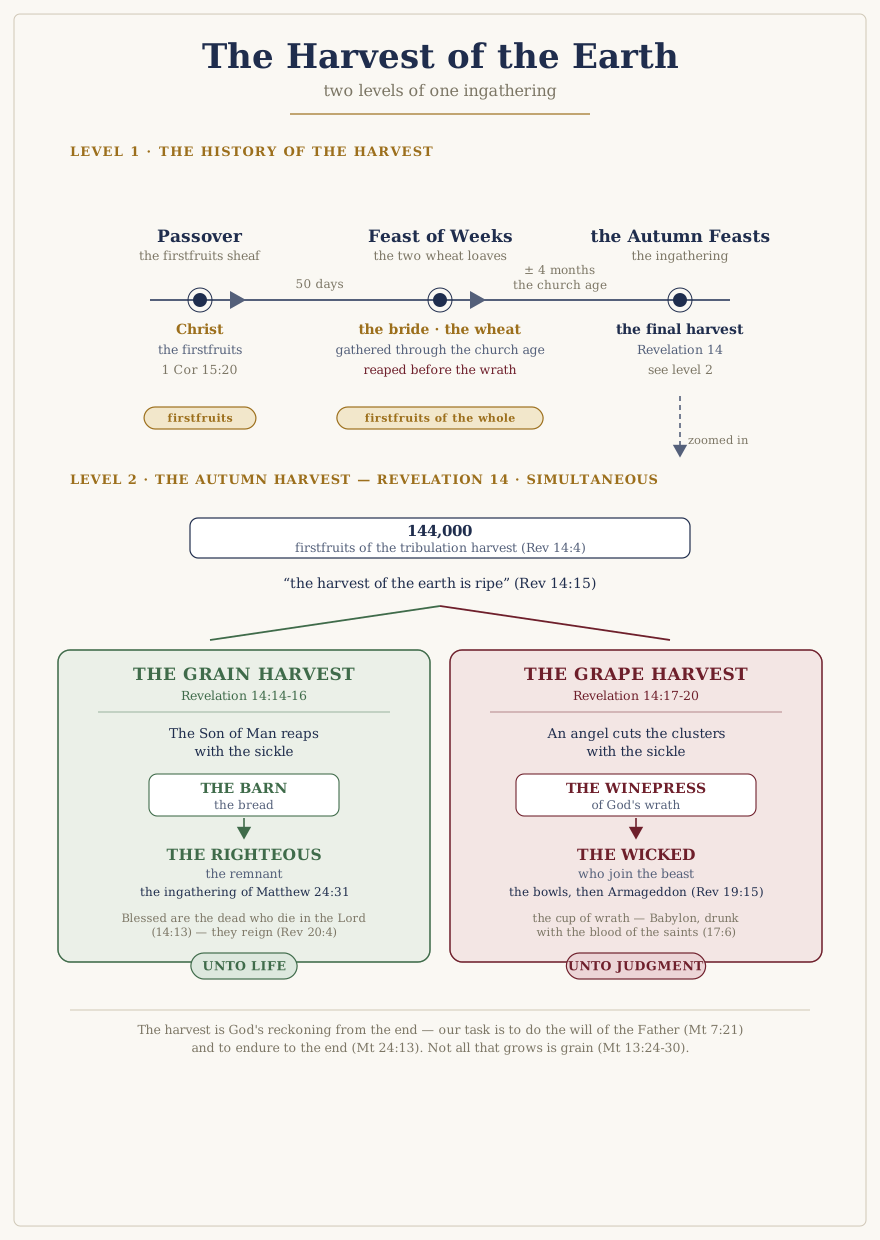
X.1 The Nested Firstfruit
"Firstfruit" is in Scripture a relative word. It is the first, God-dedicated part of a given harvest, and every harvest has one — as a house knows a firstfruit of sons and a land a firstfruit of fruits. Three firstfruits lie nested.
Christ is the Firstfruit — "the firstfruits of them that slept" (1 Cor 15:20), the wave-sheaf that was waved on the morning after the Passover, the pledge of the whole resurrection-harvest. The Bride is the firstfruit of the whole world-harvest: the wheat of the Feast of Weeks, gathered in through all the ages and reaped away before the wrath — "that we should be a kind of firstfruits of his creatures" (James 1:18). And the 144,000 are the firstfruit of Israel's own harvest — "these were redeemed from among men, being the firstfruits unto God and to the Lamb" (Rev 14:4) —: first sealed (Rev 7) and at the end with the Lamb at their destination (section VII). Firstfruit is here, as everywhere in Scripture, a cultic relation and a pledge: the word sanctifies and represents, and it does not grade — "if the firstfruit be holy, the lump is also holy: and if the root be holy, so are the branches" (Rom 11:16). Three firstfruits then, nested and each over its own harvest: Christ as pledge of all, the Bride as pledge of the world-harvest, the 144,000 as pledge toward the nation out of which they are taken (Rom 11:26). And the Bride and Revelation 14 are thereby two distinct reapings — the Bride earlier, the 144,000 as the opening of the harvest that is brought in later —, not two phases of one company.
X.2 Two Levels, and They May Not Run Together
Here lies a distinction that must be kept pure, lest the feast-typology be turned against itself. There are two levels, and the season-order belongs on the one, not on the other.
The first level is the harvest-history in its whole — the three harvest-times of the feast-calendar, each separated by a pause. Passover and the wave-sheaf (Christ); then, after fifty days, the Feast of Weeks with the two wheaten loaves (the church, the Bride, gathered in through the church-age); and then, after the long summer of about four months, the autumn feasts — "and the feast of ingathering, which is in the end of the year, when thou hast gathered in thy labours out of the field" (Ex 23:16) — the great end-harvest. On this level the order counts: the wheat is in before the autumn; the Bride is fetched before the winepress is trodden.
The second level is within that autumn end-harvest itself, as Revelation 14 shows it. There grain and grapes are simultaneous: both are called "ripe" (14:15, 18), both reaped in the same hour — the parousia, Armageddon. The season-order (wheat before the autumn) belongs therefore on the first level, not within Revelation 14. Whoever confuses the two makes of Revelation 14 something backward-looking — as though the chapter would contain the rapture of the Bride; but the chapter looks forward. It is the end-harvest, and the Bride is not in it but before it — as the wheat is already in the barn when the winepress is set going.
X.3 The Autumn End-Harvest of Revelation 14: Two Crops, Two Destinations
Here Scripture shows the end-harvest in two crops with opposite destination, both with the sickle, both ripe, but each to its own place.
The one: the Son of man Himself, crowned on the white cloud, thrusts in the sickle — "Thrust in thy sickle, and reap: for the time is come for thee to reap; for the harvest of the earth is ripe" (14:14-16). Grain that is reaped goes to the barn and becomes bread: the righteous, "but gather the wheat into my barn" (Matt 13:30; cf. "and he will gather his wheat into the garner," Matt 3:12). This is the end-ingathering of the remnant, the same that Matthew 24:31 describes: the Son with His angels, who gather His own from the four winds (section V).
The other: an angel — not the Son — cuts the clusters, "for her grapes are fully ripe," and casts them "into the great winepress of the wrath of God" (14:17-20): the ungodly, judged. It is the same sickle, but the verbs separate the ways: the grain is reaped (therizō, to the barn), the grape gathered (trygaō, to the press). It is the old twofold division of the parable of the tares: the wheat in the barn over against the tares in the fire (Matt 13:30) — two outcomes of that one end-harvest, separated in one hour.
X.4 The Blessing of the Dead: the Guests, Not the Bride
Whether the grain of 14:14-16 is only the righteous, or rather the general end-harvest of which the grapes form the judgment-part, is the one fold that Scripture here does not settle; the model lets both readings stand (X.7). But the text-own signs lean strongly toward the first: the Son reaps the grain (no angel), the grain goes not into the press, and — decisively — just before the grain-harvest sounds the blessing that interprets it.
Immediately before the sickle it sounds: "Blessed are the dead which die in the Lord from henceforth" (14:13). That "from henceforth" (ap' arti) stands after the beast-warning (14:9-12): it blesses precisely whoever dies in the beast-time in the Lord — the tribulation-martyrs, who refused the mark, who "rest from their labours; and their works do follow them." The grain-harvest that immediately follows is the ingathering of these blessed dead: they who shortly live and reign with Christ "the thousand years" (Rev 20:4). Thus 14:13 draws the grain unambiguously to the side of the righteous — and points out the guests, not the Bride: not the bridal company, which already stands before the throne (Rev 7), but whoever died in the Lord under the beast, gathered in as the grain, reigning as kings through victory. The grain-harvest of Revelation 14 is therefore no second wave of the Bride, but the ingathering of the distinct category of the wedding guests (section VI).
X.5 The Order of the Bowls: Grain First, Then the Grape
And the order? In Revelation 14 the grain comes first, then the grapes; in the parable of the tares first the tares, then the wheat (Matt 13:30). The fold is no loose thread, but fits into the bowl-order of the model: first the wrath, then the ingathering at the return.
The grape-harvest is, after all, the foreshadowing of the bowls — "the seven last plagues; for in them is filled up the wrath of God" (Rev 15:1) —, running out upon Armageddon, where the returning Lord Himself "treadeth the winepress of the fierceness and wrath of Almighty God" (Rev 19:15). The wrath culminates in the return, and at that return the grain is gathered in. Revelation 14 sets the two crops thematically side by side, as one tableau of the end-harvest; the timeline follows Matthew 13 and the bowls — first the press trodden, then the wheat stored at the coming of the Son. Thus the winepress of 14:19-20 is the announcement, and the bowls (Rev 15-16) with Armageddon (Rev 19) the execution — the image forward, the carrying-out after.
X.6 The Cup of Wrath: the Root Through All Scripture
The winepress is no loose metaphor but the consummation of a deep end-time theme with roots through the whole Old Testament: the cup of wrath. And the cup is a measure-for-measure: what Babylon gave the saints to drink, she now drinks herself.
Lady Babylon gave "the wine of the wrath of her fornication" to all nations to drink (14:8) and is "drunken with the blood of the saints, and with the blood of the martyrs of Jesus" (17:6) — she poured out for the saints their own blood as cruel wine. The recompense is by the same measure: whoever worships the beast, "the same shall drink of the wine of the wrath of God, which is poured out without mixture into the cup of his indignation" (14:10); Babylon receives "the cup of the wine of the fierceness of his wrath" (16:19; and double, 18:6); and sharply: "for they have shed the blood of saints and prophets, and thou hast given them blood to drink; for they are worthy" (16:6). The blood that she shed now flows out of the press (14:20).
And the Old Testament root is deep. The press that is trodden alone, the garment sprinkled — "I have trodden the winepress alone [...] and their blood shall be sprinkled upon my garments" (Isa 63:1-6) — is the direct background of 14:19-20 and 19:15. Beside it stand the cup of fury for the nations (Jer 25:15-29), the cup of trembling that was drunk out (Isa 51:17, 22), and the word of the psalm: "For in the hand of the LORD there is a cup, and the wine is red [...] but the wicked of the earth shall wring them out, and drink them" (Ps 75:8). The grape-harvest is therefore the reversal of the cup: whoever made the saints drunk with blood, now drinks himself the unmixed wine of God's wrath — and here the circle closes with section I, where the Bride precisely does not taste the wrath-cup because the Bridegroom drank it. The cup was for the Bridegroom; the dregs are for the ungodly; and the Bride goes free.
X.7 The Bolt Against Presumption, and the One Fold
Here lies a danger, and it must be expressly bolted, lest the harvest-image become a cushion for the self-assured. The harvest-image is God's reckoning from the end — it marks what shall prove ripe —, and it may never be reversed into a hold beforehand, as though whoever reckons himself to the grain were thereby grain.
Our practice is another mode than God's end-reckoning. "Not every one that saith unto me, Lord, Lord, shall enter into the kingdom of heaven; but he that doeth the will of my Father" (Matt 7:21); and "but he that shall endure unto the end, the same shall be saved" (Matt 24:13). Whoever reckons himself to the firstfruit lives already no longer as firstfruit; the wise virgin does not count her oil, she has it (section VI). We may not live out of the election — there lies the presumption —, but in the obedience that bears its fruit. And the tares keep the cut in it: not everything that grows and springs up on the field is grain (Matt 13:24-30); the darnel stands among it until the Reaper separates, and whoever would pull it up now already pulls up the wheat with it. Thus the harvest-image does not flatten into "whoever confesses, is grain"; it keeps precisely the seriousness of the readiness.
And the one fold remains honestly standing. Whether the grain of 14:14-16 is only the righteous, or rather the general end-harvest of which the grapes form the judgment-part, Scripture here does not settle; and the model lets both readings stand. The text-own signs lean toward the first (the Son reaps, the grain goes not into the press, the blessing of 14:13 precedes it), but the second is not excluded, and the model does not force it. Thus the image bears without a grasped cherry: Revelation 14 looks forward to the end, the Bride is not in it but before it, and the sharpness remains.
The honest test of this section. The feast-typology illumines, but it does not date. It gives the Bride her identity — she is the wheat — and the whole its structure — the wheat in before the autumn —, but it does not pin the rapture upon a literal Feast of Weeks: that the model sets on the sixth seal, not on a feast-day (section V). Whoever makes the feast-dates into a rapture-date over-asks the image. And the model acknowledges its price, but no longer the one that earlier editions booked: the expression degrees among the saved has lapsed (section VI.6). What bears the distinction is sequence and mode and not rank — the Bride in bridal state, the guests reigning through victory (Rev 20:4), both on the same tree and out of the same root-holiness (Rom 11:16-24). What remains is the reward-distinction that Scripture itself knows (1 Cor 3:12-15; 1 Cor 9; the talents); and that is no second-rate redemption. The framing, however, forestalls the dangers: no presumption (live not out of the election), no determinism (seen from the end), no soft universalism (the tares). This point returns in section XII.
XI. The Goel and the Chesed: the Typology That Bears the Whole
Beneath the chronology and the arguments lies a typology, and it is — more than any calculation — the soul of the model: the Goel, the redeemer, the near kinsman who saves. For the rapture is in its deepest ground no mechanism but a wedding.
The Goel is the kinsman who redeems the forfeited inheritance, marries the widow, avenges the blood, buys back the impoverished (Lev 25; Ruth 3-4). In Boaz, who redeems and marries Ruth, the image becomes pastoral: the rich kinsman bends down to the poor stranger, redeems her, and takes her to wife — and it is chesed, covenant-faithfulness, steadfast love that does not let go, that bears the whole book of Ruth. Christ is the Goel — "our kinsman," who became flesh and blood that He might as kinsman be able to redeem (Heb 2:14), and who paid the ransom not in silver but in His own blood. And this redeeming is borne by chesed — the same covenant-faithfulness that Boaz spread over Ruth, now over the Bride out of all the ages.
The rapture completes this image along the pattern of the Jewish wedding. The bridegroom pays the bride-price, goes away to prepare a place in his father's house, and returns at an hour the bride does not know to fetch her — "I go to prepare a place for you [...] I will come again, and receive you unto myself; that where I am, there ye may be also" (John 14:2-3). The closed door of the virgins (section VI) is the wedding-door; the harpazō of 1 Thessalonians 4:17 is the fetching of the bride; and the regeneration-oil of the wise virgins is the readiness of her who waits. Thus the rapture is not in the first place an escape from the wrath, but a bringing-home by the Redeemer — and the wrath-exemption is only its consequence: the Bridegroom takes His Bride away before the night strikes its heaviest hour, as Boaz took Ruth under his wing.
The honest test of this section. Typology illumines and confirms; it does not date. The Goel-reading adds no year-number and proves no chronology; its weight is devotional and corroborative. But precisely therein lies its value for this model: it shows that the position does not float upon calculation but upon the form of the redemption itself — the Redeemer who comes for His own. Whoever sees only the numbers misses the heart; and the heart is this: the cup was for the Bridegroom, and the Bridegroom comes for the Bride.
XII. The Honest Test — the Weakest Links of This Appendix
A robust position does not hide its weak points; it seeks them out, names them, and shows that the core does not need them. And it distinguishes sharply between two parts of its construction, for they have an opposite structure. The ecclesiology of this appendix — the two cohorts, the two boundaries, the one olive tree, the resurrection-order — is a fan: it rests upon several independent supports, so that the loss of a single link does not bring it down. The chronology — the year-number, the placement in time — is a chain: as strong as its weakest link. Whoever tests this appendix must know which part he tests; and the structure is defended with a firm hand, the window held with an open hand. Here then the heaviest links, honestly named.
The first — the corporate Child (Rev 12:5). Earlier editions called this the weakest link of the whole and booked it as second witness and no pillar. That judgment has been withdrawn in section IV.7, and it is not tacitly restored here. The majority reading (Child = Christ, in His historical ascension) remains venerable: Psalm 2, the throne, the woman as Israel who bears the Messiah. The model-reading does not deny it but encompasses it: the Child is the corporate Christ — the Head presupposed, the body caught up. It bears on three grounds, worked out in IV.7: the birth (Revelation 12 touches the end-time birth of the prophets verbally four times and Bethlehem not once), the name (in Paul the body bears the name of the Head, 1 Cor 12:12; Gal 3:16 with 3:29), and the narration (all retrospect in this book is qualification and never narration, while 12:5 narrates). What is honestly booked here is therefore no weakness but a price: this is not the reading of the history of interpretation, and the burden of proof lies with whoever departs from it. Two data in the chapter moreover do not choose — the devouring dragon fits Exodus 1-2 and Matthew 2 just as well as Jeremiah 51:34, where a dragon devours Zion, and 12:10 names "his Christ" beside "our brethren" without excluding either. And the fan remains a fan. Should this reading yet fall — should one read the Child only as Christ in His historical ascension — then the scroll-order of Revelation 7, the promise of Revelation 3:10 and the scene of Revelation 7:9-17 all still stand, and they still bear the rapture. The difference with the earlier edition is this: 12:5-12 no longer merely testifies along; it co-bears.
The second — the Bride/guest-boundary, and the demarcation of the church. This is anchored by section VI along two axes. The boundary Bride-over-against-not-ready rests upon readiness — a living, fruit-bearing, persevering faith —, and it is deliberately so formulated that it does not settle the dispute over the perseverance of the saints: whether the not-ready were ever truly saved, each school reads according to its own conviction, while the outcome (the ready taken away, the not-ready left behind) remains the same. Thereby the rapture-structure cannot be rejected on the grounds of any doctrine of salvation — and it is expressly no partial rapture. The boundary Bride-over-against-guests rests not upon a dispensation but upon the one olive tree (Rom 11): the Bride is the whole church of all ages, with Abraham as father of all believers (Rom 4) and together made perfect (Heb 11:40); and the guests are only those who come to faith after the closed door (Rev 19:9; Matt 25:10) — free of both dispensationalism and replacement theology. It remains honest that the seven-churches-as-spectrum reading is futuristic, and that the Bride/guest-boundary draws its precise dividing line at the rapture-door — a reading of the wedding-image, no uncontested datum. Here belongs also the open question whether the least true fruit already belongs to the Bride (with lesser crown), or whether a threshold holds; this work chooses the first, but the text does not state it unambiguously.
The third — the fan and the chain. It is the most important methodical move of the whole: separate the date-bearing chain from the structure-bearing fan. The ecclesiological structure — the two cohorts, the thlipsis/orgē-key, the ek, the two boundaries, the resurrection-order — stands strong and redundant, and largely independent of the precise year-number. The chronology stands upon a chain with one weak link. A failed year-number would prove that the dating failed, not that the Bride shares the wrath or that the great tribulation is one whole with its peak. The fan survives what the chain does not survive. Therefore: firm about the form, modest about the date.
The fourth — the open space, honestly measured out. An honest position names not only what it bears, but also what it does not decide. Four points this appendix expressly leaves open. First: the exact timing-point within the sixth seal at which the rapture falls — the multitude stands before the throne thereafter, but the precise moment within the sixth-seal-breach is not fixed. Second: the precise relation of the 144,000 — whether the number is literal or representative, and the exact moment of their coming-to-faith at the threshold (section VII.10), is held with an open hand; what stands fixed is the order of the three moments, not the calendar-point. Third: the form of the end-time sanctuary — a fully rebuilt temple or a restored altar with continual service on a sanctified place (section V) — the text leaves undecided. Fourth: the timing-point of the resurrection of the non-martyr who comes to faith after the rapture and dies before the return (section VIII) — that he rises unto life stands fixed; where within the coming-event is open. These open spaces are no leaks in the model but the honest limits of what the text bears; the model that knows its own difficult paths stands stronger than the model that pretends to have none.
XIII. Pastoral Word — Conclusion
It would betray the spirit of this whole appendix to end in the tone of calculation. What has been set out here is no calendar to grasp the day that the Father has set in His own power (Acts 1:7), but an attempt to see the form that He has revealed in His Word — the coherence between the night and the wrath, between the Bride and the guests, between the oil and the closed door, between the Redeemer and the wedding. The sharp edges have not been smoothed over; they have been named and held with an open hand, for a vision that knows its own limits honors Scripture more than one that would make everything air-tight.
And therefore there returns, at the end, the seriousness of the readiness — not as threat but as calling. Readiness is real: it is to be lost, and it is to be pursued. The oil is not kindled once and then forgotten, but kept burning; the birthright is not presumed but kept, as Esau forfeited it and found no place of repentance any more. This is no doctrine that makes watchfulness superfluous by a date, but a season-awareness that feeds it: "Watch therefore." And the ground beneath that calling is not man but the blood — the blood "that speaketh better things than that of Abel" (Heb 12:24), the emptied cup, the Bridegroom who drank the night to the dregs that the Bride should never taste it as wrath. Whoever hears this hears not first of all a scheme but a Person: the Redeemer who comes for His own, at an hour the bride does not know, to take her to Himself where He is.
The night is for the Bride, the wrath for the world, and the cup was for the Bridegroom.