13
The Lamb on Mount Zion
The squatter has his image. The squatter has his mark. The squatter has his ten kings, his False Prophet, his global broadcast, and his theological inversion engraved on the rock where the temple once stood. By every visible measure, the seventieth week's second half is his.
Then the camera lifts.
"Then I looked, and behold, a Lamb standing on Mount Zion, and with Him one hundred and forty-four thousand, having His Father's name written on their foreheads." (Revelation 14:1).
A Lamb. Standing. On a mountain. Surrounded by an army.
The eye of the storm, which began in chapter 12 with the woman and the dragon and continued in chapter 13 with the beasts, ends in chapter 14 with the counter-claim. Every element of the squatter's counterfeit kingdom examined in chapter 11 of this book is answered, here in the absolute center of the book of Revelation, by the Bridegroom's reply. Heavenly Mount Zion against the Earthly Temple Mount. The Lamb against the beast. The Father's name against the charagma. The new song against the global anthem of the eighth king. "The counter-claim has bodies on the ground" — and the bodies are gathered on a holy mountain that the squatter cannot touch.
The hundred and 144.000
They appeared earlier in the book. At the breaking of the sixth seal, while the cosmos was shaking and the kings of the earth were hiding in the rocks, an angel held back the four winds "till we have sealed the servants of our God on their foreheads" (7:3). One hundred forty-four thousand from the twelve tribes of Israel. Twelve thousand each. Sealed at the sixth seal, in the first half of the seventieth week, distributed across the nations of the diaspora and the land, walking through every demonic plague that has fallen on the earth — the locusts of the fifth trumpet that could touch only those who lacked the seal; the mark of the beast that could not be forced on those whose foreheads already bore another name. They are the avenger's protected witnesses on the ground throughout the most violent forty-two months in human history.
Now, at the close of those months, John sees them again. Not scattered. Not hiding. Standing. With the Lamb.
The text describes them in language that is almost startlingly tender. "These are the ones who were not defiled with women, for they are virgins. These are the ones who follow the Lamb wherever He goes." (14:4). The phrase not defiled with women is not a denigration of marriage; it is the language of consecrated warriors in the Old Testament, the priestly purity required of those who carried the ark or fought the Lord's battles. The 144,000 have lived as Nazarites of the seventieth week, set apart, undefiled by the spiritual fornication of the squatter's system. They have not bowed to the image. They have not taken the mark. They have not compromised theology for survival. And the text gives them the title that places them, finally, in the harvest framework traced so far:
"These were redeemed from among men, being firstfruits to God and to the Lamb. And in their mouth was found no deceit, for they are without fault before the throne of God." (14:4-5).
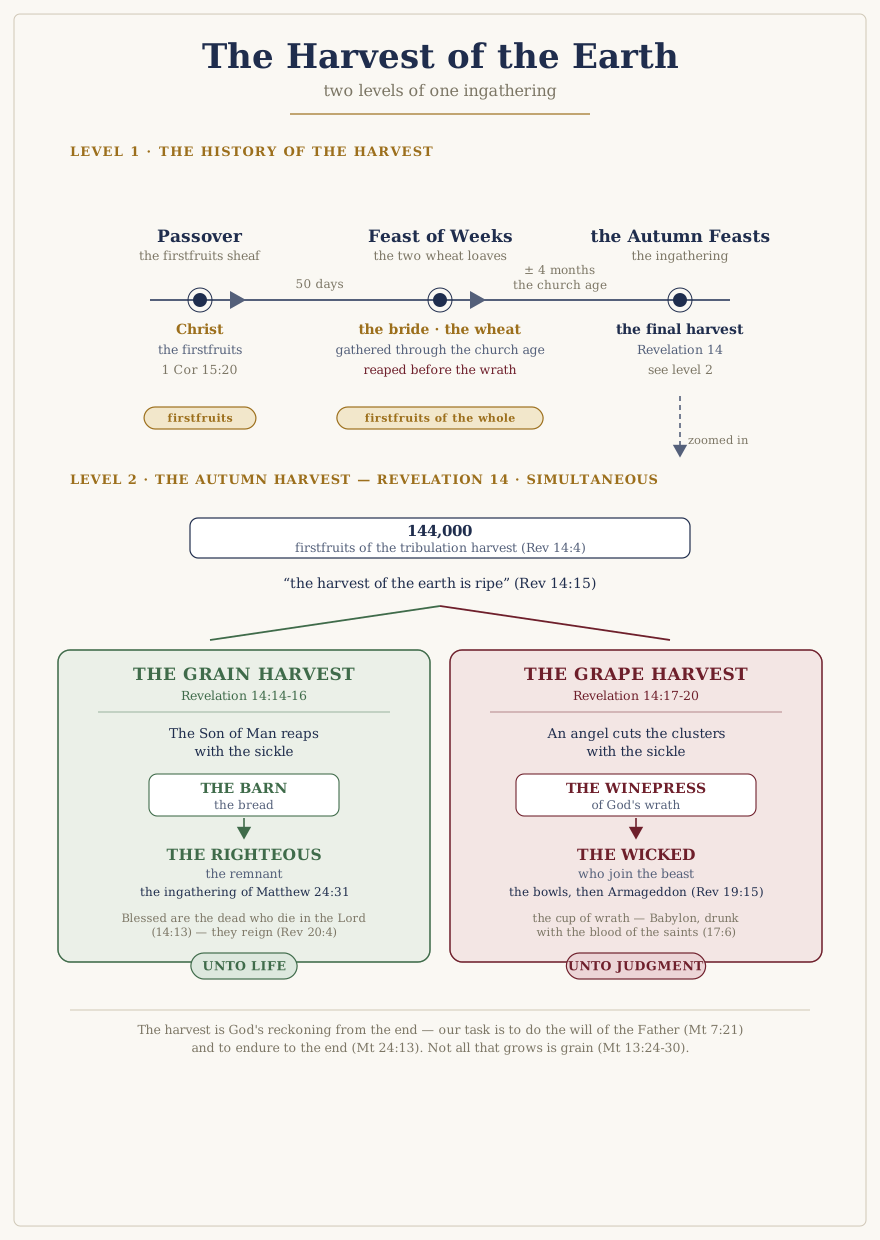
Firstfruits to God and to the Lamb. The Greek word is aparchē — the same word the apostle Paul used when he called Christ the firstfruits of the resurrection, the same word James used for the Church as the firstfruits of God's creatures. It appeared in chapter 2. And here the term must be read as Scripture uses it: firstfruit is a relative word, the first God-dedicated part of a given harvest, and it stands on more levels at once. Three firstfruits lie nested, ascending. Christ is the Firstfruit — "the firstfruits of them that slept" (1 Corinthians 15:20), the wave-sheaf, the pledge of the whole resurrection-harvest. The Bride is the firstfruit of the whole world-harvest — the wheat of the Feast of Weeks, gathered in through all the ages and reaped away before the wrath. And the 144,000 are on their level firstfruit: not the firstfruit of the whole, but of the tribulation-harvest — first sealed, and now at the end with the Lamb. So the Bride and Revelation 14 are two distinct reapings, the Bride earlier and these gathered later, not two phases of one company. Here in Revelation 14 the term lands on the 144,000 — and it must be read with the care the appendix on the Bride gives it. They are not a category outside the Bride; they are a special part of her — Messiah-confessing Israelites, brought to faith at the rapture-threshold and retroactively incorporated into the complete Bride. Within that, the firstfruits-language marks them as a pledge toward Israel the nation. They are the down payment on what Paul promised in Romans 11:26 — "all Israel will be saved." The 144,000 are the guarantee that Israel as a nation will, at the Redeemer's return, see the One they pierced and weep over Him as one mourns an only son. The full national turning of Israel is still ahead, in the days when our Redeemer sets His feet on the Mount of Olives. But this Messiah-confessing part of the Bride is already standing on Mount Zion, signed and sealed and singing.
The new song
"And I heard a sound from heaven, like the sound of many waters, and like the sound of loud thunder. And I heard the sound of harpists playing their harps. They sang as it were a new song before the throne, before the four living creatures, and the elders; and no one could learn that song except the hundred and forty-four thousand who were redeemed from the earth." (14:2-3).
A new song. Sung only by those who have lived through what they have lived through. The throne room cannot teach this song to anyone else. The angels cannot sing it. The Gentile saints in the white robes from chapter 7 cannot sing it. Only those one hundred forty-four thousand Israelite witnesses, who walked through the seventieth week as marked men with the seal of the living God on their foreheads, who saw the abomination on the temple mount and refused to bow, who watched the mark be enforced and refused to take it, who survived the trumpets and the persecution and the legions of demons released from the Abyss — only they can sing what they have learned.
Every great song in the Bible has been the song of those who came through. Moses sang on the far shore of the Red Sea. David sang in the cave of Adullam. Hannah sang when the Lord broke her barrenness. Mary sang when our Redeemer was conceived in her womb. The redeemed sing what their experience has taught them. The 144,000 sing their own.
The Lamb stands at the center of the gathering. The Father's name is on their foreheads — the visible counter-mark to the charagma — and the song rises from voices the squatter could not silence.
The first angel — the everlasting gospel
The counter-claim does not stay on Mount Zion. It is broadcast.
"Then I saw another angel flying in the midst of heaven, having the everlasting gospel to preach to those who dwell on the earth — to every nation, tribe, tongue, and people — saying with a loud voice, 'Fear God and give glory to Him, for the hour of His judgment has come; and worship Him who made heaven and earth, the sea and springs of water.'" (14:6-7).
An angel flies in the open sky over the entire earth, preaching the everlasting gospel to every nation. This is one of the most striking images in the entire book. With the squatter's broadcast network in full operation, with the False Prophet's image speaking in every public square, with the mark enforced and the saints in hiding — our Redeemer sends an angel. The squatter does not get to control the airwaves at the close of the seventieth week. The Father puts an angel into the sky over the planet, audible to every tribe and tongue, preaching the gospel that has been preached since Eden: fear God, give Him glory, the hour of His judgment is here, worship the One who made it all.
Notice what the gospel is. It is not a denominational creed. It is not a doctrinal statement requiring catechism. It is the original fear-and-worship claim of the universe: the Creator has come to judge, and the only safe place is in His presence. It is the gospel Adam should have remembered. It is the gospel Noah preached. It is the gospel Jonah preached to Nineveh. It is the gospel Paul preached to the Athenians on Mars Hill. It is the eternal gospel — older than Israel, older than the Church, as old as the relationship between Creator and creature.
The angel preaches it in the closing days. The squatter's broadcast cannot drown it out. The mark cannot suppress it. Some hear and turn. Some hear and refuse. The gospel runs to every audience the planet still contains, and the avenger's mercy is given one final, planetary platform.
The second angel — Babylon is fallen
A second angel follows the first. "And another angel followed, saying, 'Babylon is fallen, is fallen, that great city, because she has made all nations drink of the wine of the wrath of her fornication.'" (14:8).
Babylon is fallen. Past tense. The verdict is announced as accomplished, even though the physical execution will not come for another chapter or two in John's vision. The heavenly court has rendered the sentence. The squatter's last city is condemned. The wine she has poured for the nations — the intoxicating mixture of wealth, sexual corruption, religious counterfeit, and political domination — has been measured against the Father's bowl, and her bowl is heavier. She has been weighed. She is found wanting. She is fallen.
This is the same Babylon that chapters 17 and 18 of Revelation present in detail — the great harlot, the false bride, the squatter's counter-Jerusalem. She has been the program since Genesis 11. She has worn many faces — Babel, Nineveh, Babylon-on-the-Euphrates, Rome, the medieval power, the modern global empire of Mammon — but she has been one woman the whole time. The second angel's announcement is the formal funeral notice for a four-thousand-year project. The squatter's counterfeit bride is dead.
The Bride of the Lamb is alive on Mount Zion, singing.
The third angel — the fate of the marked
The third angel speaks the most terrible words in the book of Revelation, and they are not softened here.
"Then a third angel followed them, saying with a loud voice, 'If anyone worships the beast and his image, and receives his mark on his forehead or on his hand, he himself shall also drink of the wine of the wrath of God, which is poured out full strength into the cup of His indignation. He shall be tormented with fire and brimstone in the presence of the holy angels and in the presence of the Lamb. And the smoke of their torment ascends forever and ever; and they have no rest day or night, who worship the beast and his image, and whoever receives the mark of his name.'" (14:9-11).
The mark is not a survival decision. The mark is a worship decision. To take the charagma is to accept the squatter's branding as one's own and to publicly worship the beast as God. The third angel's announcement is given in advance — broadcast across the planet from the open sky — so that no one who takes the mark can later claim ignorance. The wine of the Father's wrath, poured full strength without the dilution of mercy that has characterized every prior judgment, is reserved for those who chose the squatter when the choice was clear.
That cup is no loose figure of speech. It is the consummation of a theme that runs through the whole of Scripture — the cup of wrath — and the measure of it is a recompense like for like. Babylon made all the nations drink of "the wine of her fornication" (14:8) and became "drunk with the blood of the saints and with the blood of the martyrs of Jesus" (17:6) — she poured out for the saints their own blood as cruel wine. Now the cup turns back: "for they have shed the blood of saints and prophets, and You have given them blood to drink, for they are worthy" (16:6); Babylon receives the cup of the wine of the wrath of God back double (16:19; 18:6). And the root reaches deep into the Old Testament: the press that the LORD treads alone and the garment sprinkled with blood (Isaiah 63:1-6 — the direct background of this winepress and of the white horse in chapter 19), the cup of fury for the nations (Jeremiah 25:15-29), the cup of trembling that is drunk out (Isaiah 51:17, 22), and the word of the psalm: "In the hand of the LORD there is a cup, and the wine is red [...] all the wicked of the earth shall wring them out and drink them, even to the last dregs" (Psalm 75:8). The grape-harvest is the reversal of that cup. Whoever made the saints drink blood now drinks himself the unmixed wine of God's wrath — while the Bride precisely never tastes that cup, because the Bridegroom has drained it to the dregs.
Tormented with fire and brimstone in the presence of the holy angels and in the presence of the Lamb. The image is precise. The torment is not in some sealed-off compartment of the universe; it is in the presence of the Lamb. The witnesses of the torment are the holy angels and the Lamb Himself. The smoke of their torment ascends forever and ever. Eternity is the duration. No rest day or night — the mirror of the cherubim's day and night they do not rest praising God in the throne room. The marked have their own perpetual non-rest, in fire instead of in worship.
Chapter fifteen of this book examines the lake of fire in detail, where Bozrah and Armageddon and the second death are addressed in full. For now, the third angel's announcement gives the binary that will close the seventieth week. To worship the beast is to drink the wine of the wrath of God. There is no third option. The squatter's deception that the mark is a neutral economic transaction is exposed in this proclamation as a lie. Every mark is a worship. Every worship is an eternal commitment. The world has been told.
The angel's announcement is followed by a single verse of pastoral encouragement, and it should not be passed without noting the proportion. "Here is the patience of the saints; here are those who keep the commandments of God and the faith of Jesus." (14:12). The patience required to keep faith through the seventieth week is the patience of those who know what the third angel has just announced. The saints are not naive martyrs; they are martyrs with full information. They die rather than take the mark because they know what the mark costs. Their patience is informed patience. Their faith is informed faith.
And precisely here lies a bolt that must not be forgotten. The harvest-image is God's reckoning from the end — it marks what shall prove ripe — and it may never be reversed into a hold beforehand, as though whoever reckons himself to the grain were thereby grain. That is exactly the presumption against which our Redeemer warned: "not everyone who says to Me, Lord, Lord, shall enter the kingdom of heaven, but he who does the will of My Father" (Matthew 7:21), and "he who endures to the end shall be saved" (Matthew 24:13). We may not live out of the election; whoever reckons himself to the firstfruit lives already no longer as firstfruit. And the tares keep the cut in it: not everything that springs up on the field is grain (Matthew 13:24-30) — the darnel stands among it until the Reaper separates, and whoever would pull it up now already pulls the wheat with it. Therefore this harvest does not flatten into "whoever confesses is grain"; precisely the seriousness of the readiness remains standing.
And then the voice from heaven, addressing the dead: "Blessed are the dead who die in the Lord from now on [...] that they may rest from their labors, and their works follow them." (14:13). The slain saints of the seventieth week are blessed from now on — the temporal marker is precise. The blessing is in the rest from their labors, and in the works that follow them into the throne room. Nothing they have done is wasted. Every prayer, every refused mark, every quiet act of faithfulness in the fugitive months, is filed in the heavenly record.
The Son of Man on the cloud
The eye of the storm closes with two harvests, both announced in the same vision but distinct in their object.
"Then I looked, and behold, a white cloud, and on the cloud sat One like the Son of Man, having on His head a golden crown, and in His hand a sharp sickle. And another angel came out of the temple, crying with a loud voice to Him who sat on the cloud, 'Thrust in Your sickle and reap, for the time has come for You to reap, for the harvest of the earth is ripe.' So He who sat on the cloud thrust in His sickle on the earth, and the earth was reaped." (14:14-16).
The Son of Man on a white cloud. A golden crown — the stephanos of the conqueror, given by the Father at the seventh trumpet's investiture. A sharp sickle. The harvest of the earth — the grain, the wheat — is ripe, and the King thrusts in the sickle and gathers it. This is the harvest of the wedding guests — the believers who came to faith after the catching-away, who refused the mark and held the perseverance of the saints. They are not to be confused with a later portion of the Bride still ripening; the Bride is one full multitude and has already been taken up in her entirety. These are a distinct category of the redeemed — those who have been brought in after the door has closed. The two witnesses are already home. The 144,000, the Messiah-confessing part of the Bride, are gathered on Mount Zion. Now this grain harvest of the guests is brought into the barn.
One fold is honestly left standing, for Scripture does not settle it here. Whether this grain is only the righteous — the wedding guests, sharply over against the grapes — or rather the general end-harvest of which the grapes form only the judgment-part, the text does not say in so many words. The signs lean toward the first (the Son reaps, the grain goes not into the press, the blessing of verse 13 precedes it), but the second reading is not excluded, and it is not forced here. Both are left standing; what stands fixed in either case is that the Bride is not gathered in here but is already stored.
But the chapter does not end with the grain harvest. It ends with a second harvest, of a different crop, in a different vat.
"Then another angel came out of the temple which is in heaven, he also having a sharp sickle. And another angel came out from the altar, who had power over fire, and he cried with a loud cry to him who had the sharp sickle, saying, 'Thrust in your sharp sickle and gather the clusters of the vine of the earth, for her grapes are fully ripe.' So the angel thrust his sickle into the earth and gathered the vine of the earth, and threw it into the great winepress of the wrath of God. And the winepress was trampled outside the city, and blood came out of the winepress, up to the horses' bridles, for one thousand six hundred furlongs." (14:17-20).
The grapes. The third harvest of the year — the wine harvest of Sukkot, the autumn vintage that completes the agricultural calendar. Here two levels must be kept apart, or the image turns against itself. On the level of the harvest-history the three harvest-times stand after one another, each with a pause: the wave-sheaf of Passover (Christ), after fifty days the wheat of the Feast of Weeks (the Bride, gathered in through the church-age), and after the long summer the autumn harvest. On that level the order holds: the wheat is in before the autumn, the Bride is fetched before the winepress is trodden. But within Revelation 14 itself the crops do not lie after one another — grain and grapes are both called ripe here, both reaped in the same hour, the parousia. The season-order belongs therefore on the level of the harvest-history, not within this chapter. Whoever confuses the two makes of Revelation 14 something backward-looking, as though it would contain the rapture of the Bride. But the chapter looks forward: it is the end-harvest, and the Bride is not in it but before it. This grape-harvest is not the harvest of the Bride. This is the harvest of those who allied themselves with the squatter, who took the mark, who worshiped the beast, who refused the gospel preached by the angel in the open sky. The clusters are fully ripe — the squatter's kingdom has matured into the form the avenger requires for the verdict. The angel with the sickle gathers the grapes. They are thrown into the winepress of the wrath of God. The winepress is trampled outside the city — outside Jerusalem, on the plain of Megiddo, where the kings of the earth will gather to fight the Lamb.
The blood flows. The text gives a measurement — up to the horses' bridles, for one thousand six hundred furlongs. About 200 miles. The valley of Armageddon and the surrounding plain, drowned in the blood of the squatter's kingdom. The third harvest is the harvest of the wicked, and it is reserved for the bowls.
This is the announcement. The execution is still ahead.
Stepping toward the bowls
The eye of the storm closes here. The Lamb stands on Mount Zion. The 144,000 sing their new song. The everlasting gospel has been broadcast to every tribe and tongue. Babylon has been declared fallen. The fate of the marked has been announced in advance. The grain harvest — the wedding guests, a distinct category of the redeemed — is gathered. The wine harvest is announced as ripe.
Everything that has been described in chapters 12 through 14 — the dragon, the beasts, the witnesses, the Lamb, the harvests — is the spiritual machinery that has been driving every event since the first seal broke. The eye of the storm has shown the why of the seventieth week. The dragon was cast down. The beast was raised from the Abyss. The witnesses were sent. The Bride was gathered. The mark was enforced. The verdict was announced. The harvests were declared.
What remains is the executive stride.
The seventh trumpet has sounded. The third woe has begun. The seven angels are about to receive seven bowls of the wrath of God, full strength, no fractions, no delay. Forty-five days of compressed final judgment. The bowls fall on the squatter's kingdom in a closing sequence that will leave nothing standing for the beast to rule.
And when the last drop has fallen, when the last bowl has been emptied, when the last broadcast of the squatter's image has gone dark — our Redeemer will mount His white horse, the heavens will open, and the King will come for His Bride.
The bowls are about to fall.